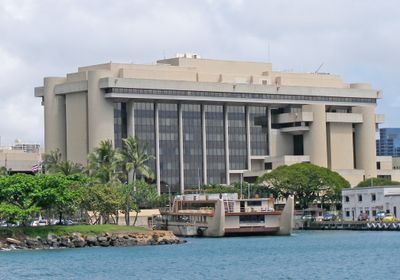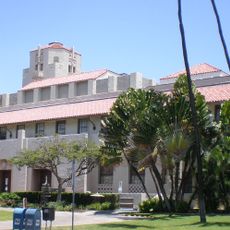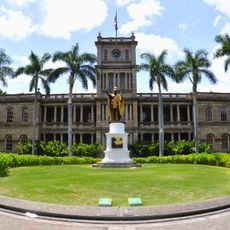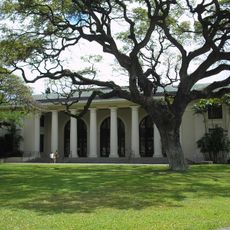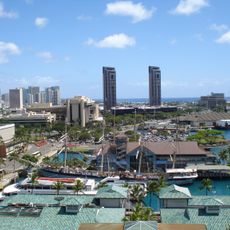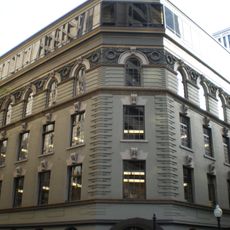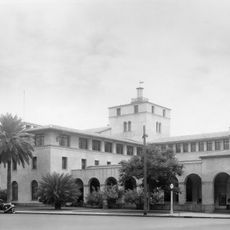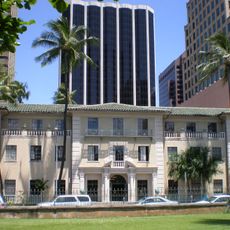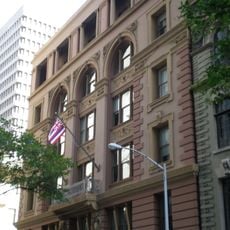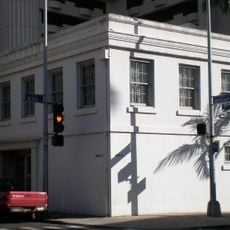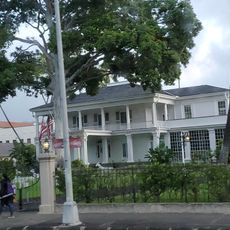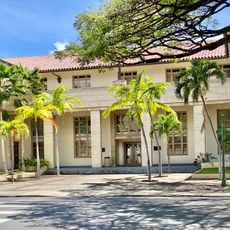
Prince Kuhio Federal Building, Federal building and courthouse in Honolulu, United States
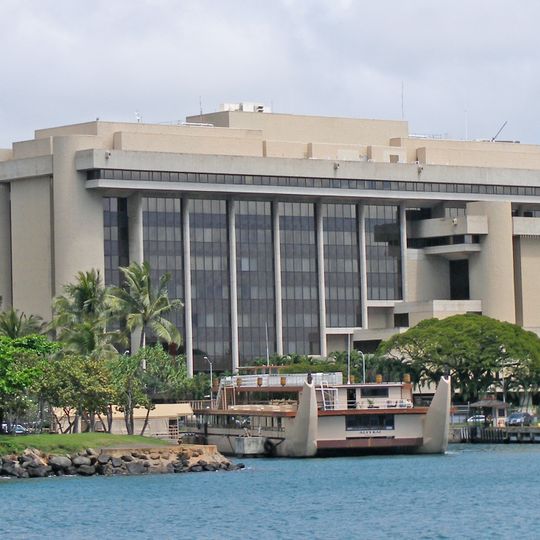
The Prince Kuhio Federal Building contains a ten-story office tower connected to a six-story courthouse through an enclosed pedestrian bridge.
The 1977 structure stands on the former site of Fort Armstrong, replacing an earlier federal complex that served customs and postal operations near Iolani Palace.
The building bears the name of Prince Jonah Kuhio Kalanianaole, who represented Hawaii as a territorial delegate to Congress from 1903 to 1922.
The federal building houses 57 government agencies, including the United States District Court for Hawaii and the U.S. Court of Appeals Ninth Circuit Honolulu Division.
A 2015 renovation added a nine-story atrium with natural light penetration and implemented systems that reduced energy consumption by thirty percent.
Location: Honolulu
Inception: 1977
Architectural style: brutalism
GPS coordinates: 21.30361,-157.86222
Latest update: March 5, 2025 08:54
Brutalist architecture emerged in the decades following World War II, producing buildings that challenged conventional design through their honest expression of materials and function. From Le Corbusier's Unité d'Habitation in Marseille to Louis Kahn's National Assembly in Dhaka, these structures define a global movement that prioritized raw concrete, bold geometric forms and exposed construction elements. The style reached across continents, shaping university libraries in Chicago, government buildings in Boston and Chandigarh, residential towers in London, and cultural centers in São Paulo. Each building reflects the architectural philosophy of its time, when architects sought to create functional spaces through direct expression of structure and material. This collection documents examples from Europe, Asia, North and South America, representing the full range of building types that defined the movement. You'll find administrative complexes that house parliaments and municipal offices, educational facilities serving major universities, residential towers providing urban housing, and cultural institutions including museums and theaters. The structures share common characteristics—concrete left exposed to show its texture and formwork patterns, geometric compositions that emphasize mass and volume, and architectural elements that reveal rather than conceal how buildings stand and function. These sites offer insight into a period when architects reimagined how modern cities could be built and how public spaces could serve their communities.
ʻIolani Palace
476 m
Hawaii State Capitol
654 m
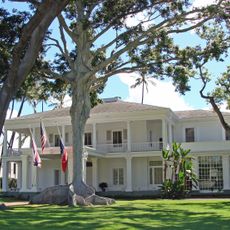
Washington Place
810 m
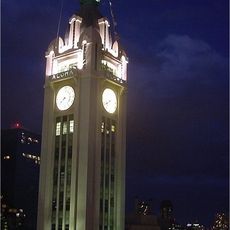
Aloha Tower
548 m
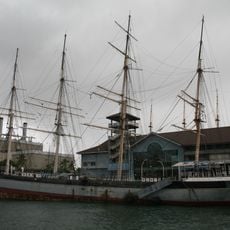
Falls of Clyde
370 m
First Hawaiian Center
427 m
Honolulu Hale
532 m
Aliiolani Hale
296 m
Hawaii Theatre
782 m
Hawaii State Library
599 m
Hawaii State Public Library System
679 m
Hawaii State Art Museum
699 m
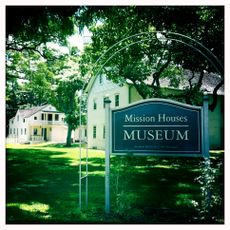
Mission Houses Museum
565 m
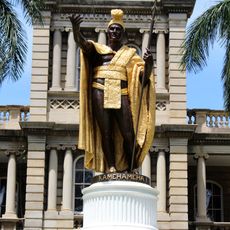
Kamehameha Statue
355 m
Hawaii Maritime Center
350 m
Merchant Street Historic District
625 m
King David Kalakaua Building
328 m
YWCA Building
786 m
Lunalilo Mausoleum
414 m
United States Immigration Office
470 m
Kakaako Pumping Station
358 m
Royal Brewery
332 m
Stangenwald Building
550 m
Melchers Building
661 m
Kapuāiwa Building
652 m
Washington Place
805 m
Hale Auhau
236 m
Kanaina Building
537 mReviews
Visited this place? Tap the stars to rate it and share your experience / photos with the community! Try now! You can cancel it anytime.
Discover hidden gems everywhere you go!
From secret cafés to breathtaking viewpoints, skip the crowded tourist spots and find places that match your style. Our app makes it easy with voice search, smart filtering, route optimization, and insider tips from travelers worldwide. Download now for the complete mobile experience.
A unique approach to discovering new places❞
— Le Figaro
All the places worth exploring❞
— France Info
A tailor-made excursion in just a few clicks❞
— 20 Minutes