Dry Creek Archeological Site, Archaeological site near Healy, Alaska, US
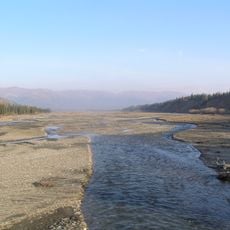
Dry Creek Archeological Site is an archaeological location near Healy in Alaska containing distinct soil layers stacked above glacial deposits. These stratified remains offer insights into ancient human occupation patterns in the interior of Alaska.
C. E. Holmes discovered the site in 1973, and major excavations followed in the late 1970s, with further research in the 1990s. It was listed on the National Register of Historic Places in 1974 and declared a National Historic Landmark in 1978. The stratified deposits span from roughly 11,000 years ago to 2600–1400 BCE.
The site's two oldest layers, dated to 8,500–9,000 BCE, held microblade technology and chindadn projectile points linked to the Nenana complex, while the younger component contained notched points. Animal bones show processing of Dall sheep, wapiti, and steppe bison, indicating shifting hunting practices.
Public access to the site is restricted and protected under federal and state regulations. This closure is in place to preserve the archaeological materials from damage and looting.
The oldest component, dated to 8,500–9,000 BCE, yielded more than 3,500 artifacts, mostly stone flakes. Among them is a scraping tool with a triangular head measuring 31 by 16 millimetres. The site also has one of the few Alaskan interior finds of notched projectile points, from the youngest component (2600–1400 BCE).
The community of curious travelers
AroundUs brings together thousands of curated places, local tips, and hidden gems, enriched daily by 93,578 contributors worldwide.