Teatro Macedonio Alcalá, Opera house and theatre in central Oaxaca de Juárez, Mexico.
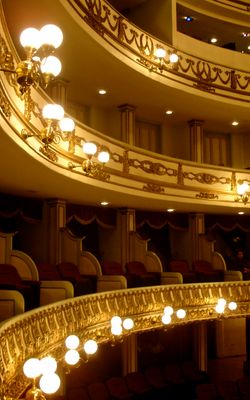
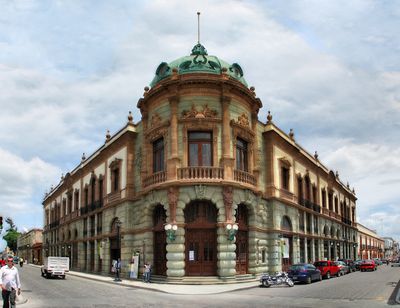
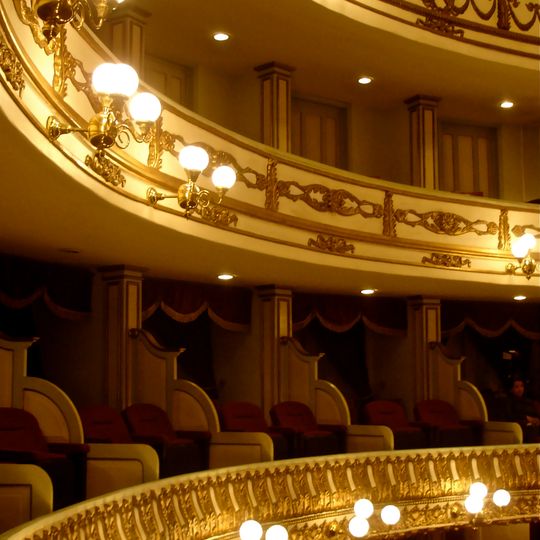
Teatro Macedonio Alcalá is a theatre on a corner in central Oaxaca de Juárez, built 1904–1909 in French-influenced modernist style. Its rusticated grey stone base has three wooden double doors framed by stacked rounded columns and globe lamps; a stone balustrade wraps the corner balcony, and a green copper dome with a thin spire tops the corner turret. Inside, cream and gold tiers of box seating with red upholstered seats curve above a gold-decorated lower balcony.
The building was constructed between 1903 and 1909 and was originally named Teatro-Casino Luis Mier y Terán before receiving its current name in the 1930s. This renaming marked a shift in the theater's role and importance for the city.
The theatre's name, adopted in the 1930s, honours the 19th-century Oaxacan musician Macedonio Alcalá, composer of the waltz "Dios nunca muere". Before that it was called Teatro Casino Luis Mier y Terán, then General Jesús Carranza during the Revolution. Its French-style Louis XV lobby, with a white marble staircase, has a ceiling allegory depicting the Temple of Art, where Fame and Prize triumph.
The theatre stands on a street corner in the centre of Oaxaca de Juárez, with its angled corner entrance marked by three wooden double doors under a rounded balcony. It reopened in 2004 after remodelling following the 1999 earthquake, and since then it has been used only for cultural events. Look for the green quarry-stone arches over the main doors before going in.
The theatre's ceiling carries an allegorical painting called the Temple of Art, in which Fame and Prize triumph. The white marble staircase of the Louis XV-style lobby leads beneath it. The building was renamed in the 1930s after Macedonio Alcalá, composer of the waltz "Dios nunca muere".
The community of curious travelers
AroundUs brings together thousands of curated places, local tips, and hidden gems, enriched daily by 92,724 contributors worldwide.