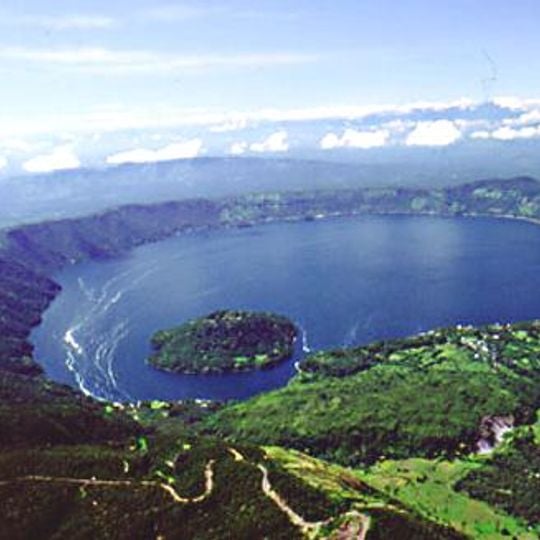
Coatepeque Caldera, Volcanic lake in Santa Ana Department, El Salvador
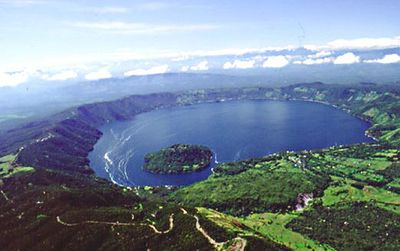
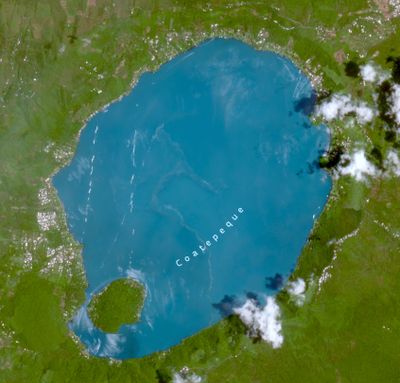
Coatepeque Lake sits inside a volcanic crater and is a large body of water that displays different shades of blue. The water reaches great depths and is surrounded by steep crater walls.
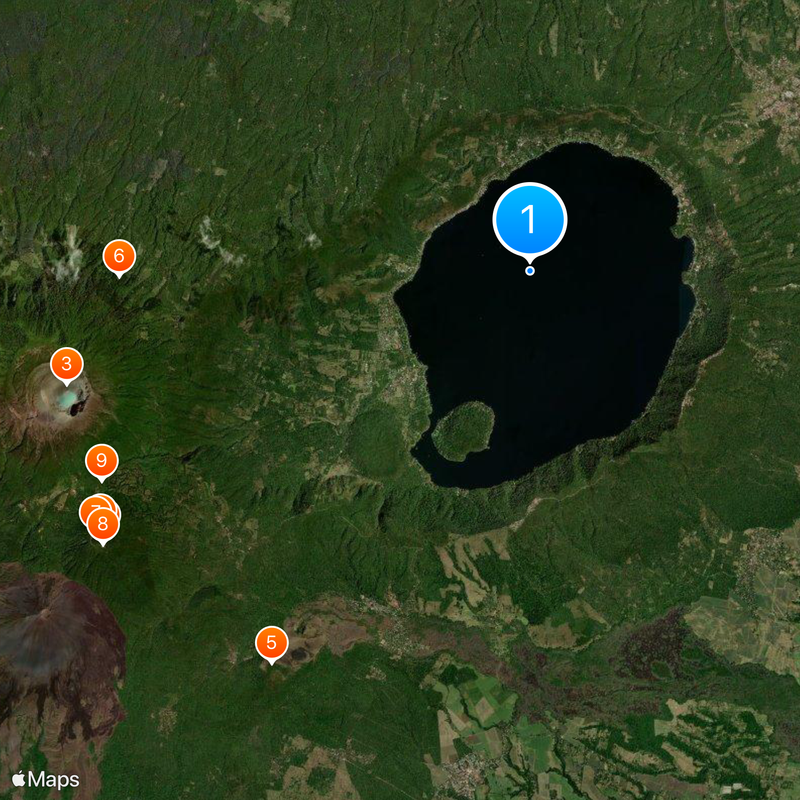
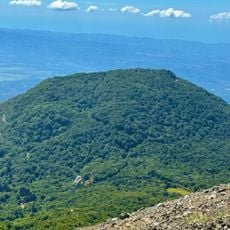
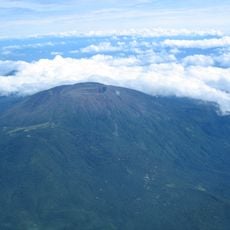
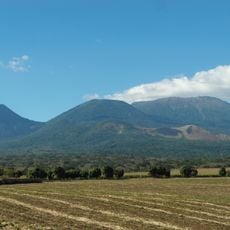
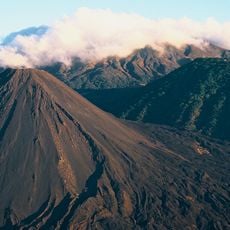
The Coatepeque caldera formed during a series of rhyolitic explosive eruptions from a group of stratovolcanoes between about 72,000 and 57,000 years ago. Later basaltic cinder cones and lava flows appeared near the west edge, and six rhyodacitic lava domes rose, the youngest being Cerro Pacho, formed after 8000 BC. The lake occupies the eastern part of the caldera.
The name comes from the Nawat language meaning "at the snake hill". The island of Teopan holds ancient Maya remains that speak to a long history of settlement in this place.
The lake lies 18 km south of Santa Ana city, between Santa Ana Centro and the El Congo district of Santa Ana Este. The two peninsulas called "los anteojos" and the lava-dome shore rocks help with orientation. Hot springs occur near the lake margins. The site was declared a protected natural reserve on 17 February 2023.
The lake's colour has shifted from blue to turquoise in 1998, 2006, 2012, 2016, 2017, 2018 and 2019, according to El Salvador's environment ministry, which calls it a cyclical phenomenon. The island of Teopan is a lava dome 80 to 100 m high and about 1 km across, where Pipil people kept a temple and a Late Preclassic "barrigones" monolith venerated as the goddess Itzqueye.
The community of curious travelers
AroundUs brings together thousands of curated places, local tips, and hidden gems, enriched daily by 92,722 contributors worldwide.