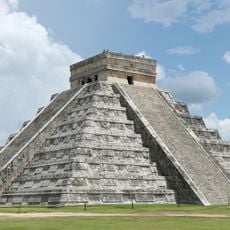
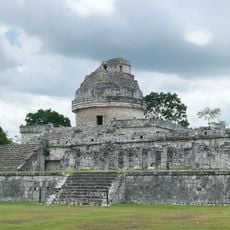
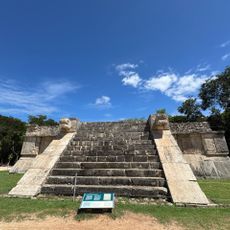
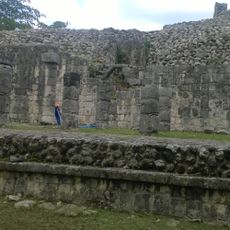
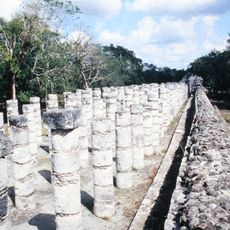
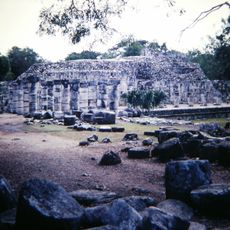
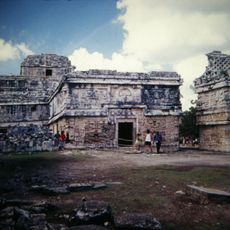
Akab Dzib, Maya archaeological ruins at Chichen Itza, Mexico.
Akab Dzib is a Maya-era building with multiple chambers and doorways on its facade. The structure displays typical architectural features with a staircase and solid walls characteristic of administrative buildings from this period.
Akab Dzib dates to around 869 AD and was built in the Puuc architectural style. Glyphs in the Casa Colorada give an earlier name, Wa(k)wak Puh Ak Na, "the flat house with the excessive number of chambers", and identify it as the home of the Chichén Itzá administrator Yahawal Cho' K'ak' of the Kokom dynasty. The INAH completed a restoration in 2007.
The name Akab Dzib means "House of Mysterious Writing" in Maya, after the carved glyphs on the lintel above the inner doorway at the southern end. A carved panel in the doorjamb shows a seated figure surrounded by more glyphs. An earlier name recorded in the Casa Colorada glyphs is Wa(k)wak Puh Ak Na, "the flat house with the excessive number of chambers."
The building is accessible through the Chichen Itza archaeological site and can be viewed from the outside. Visitors can examine the architecture from different angles and look closely at carved details and entrances.
The building's earlier name, Wa(k)wak Puh Ak Na, comes from glyphs in the Casa Colorada and means "the flat house with the excessive number of chambers." It was the home of Yahawal Cho' K'ak' of the Kokom dynasty, the administrator of Chichén Itzá.
The community of curious travelers
AroundUs brings together thousands of curated places, local tips, and hidden gems, enriched daily by 93,870 contributors worldwide.