Buttermilk Creek Complex, Archaeological site in Bell County, Texas.
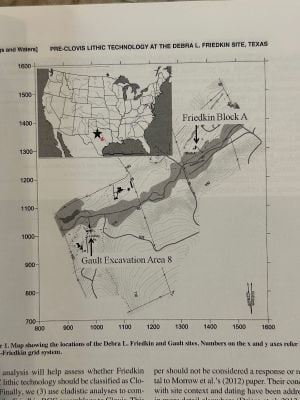
The Buttermilk Creek complex lies in a dry creek bed at the Debra L. Friedkin site, 250 m downstream from the Gault site. Its 15,528 stone artifacts, all but one of Edwards chert, sit in a 20 cm layer of clay sediment beneath a 2.5 cm Clovis layer. The finds include 12 projectile points with bifacial edge retouch but no fluting.
Michael Waters of Texas A&M University began digging the Debra L. Friedkin site in 2006, 250 m downstream from the Gault site. Optically stimulated luminescence dated the artifact layer to 13,200–15,500 years before present, beneath a 2.5 cm Clovis layer. The 15,528 stone pieces, almost all Edwards chert, include twelve unfinished projectile points without the Clovis basal flute.
The tools were knapped from Edwards chert gathered nearby. Flint knapping with hammer stones and antler billets shaped bifaces, while smaller antlers pressure-flaked spear points, knives, blades and bladelets. Twelve projectile points show edge retouch but lack the fluting of later Clovis points.
The Debra L. Friedkin site lies along Buttermilk Creek southwest of Belton in Bell County, about 250 metres downstream from the Gault site. Excavation blocks sit on two Pleistocene floodplain terraces, with the pre-Clovis layer in Block A buried under 1.4 metres of clay and colluvium. The deposit is an active research site, so access depends on the Texas A&M excavation team.
The discovery represents one of the oldest confirmed human settlements in North America, with optically stimulated luminescence dating techniques providing evidence that challenges the Clovis-first model of continental peopling.
The community of curious travelers
AroundUs brings together thousands of curated places, local tips, and hidden gems, enriched daily by 92,841 contributors worldwide.