Millimeter Anisotropy eXperiment IMaging Array, Radio telescope and cosmic microwave background experiment in Palestine, Texas, United States.
The Millimeter Anisotropy eXperiment IMaging Array (MAXIMA) was a balloon-borne telescope that measured cosmic microwave background fluctuations. A 1.3-metre primary mirror with secondary and tertiary mirrors focused microwaves onto feed horns with bands at 150, 240 and 420 GHz and 10-arcminute resolution. Sixteen NTD-Ge thermistor bolometers, cooled to 100 mK by a four-stage refrigeration system, detected the radiation.
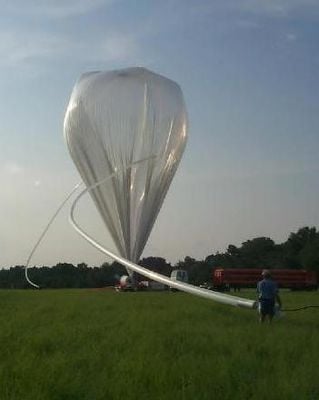
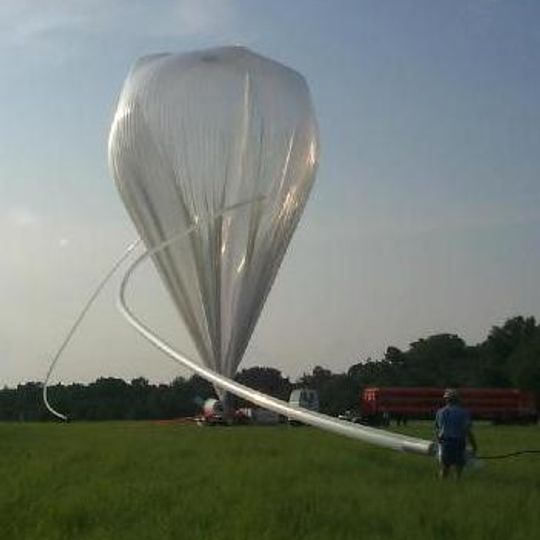
MAXIMA was planned alongside the BOOMERanG experiment but split off during planning, cutting flight time and launching and landing on U.S. soil. Two flights lifted off from the Columbia Scientific Balloon Facility in Palestine, Texas, in August 1998 and June 1999, each reaching 40,000 metres for over eight hours. The first surveyed about 0.3 percent of the northern sky near Draco; MAXIMA-II doubled the area toward Ursa Major.
MAXIMA was run by an international collaboration headed by the University of California and funded by the NSF, NASA and the Department of Energy. It was first planned together with the BOOMERanG experiment, then split off during planning to fly shorter missions that launched and landed on U.S. territory.
MAXIMA had no fixed site: each flight lifted off from the Columbia Scientific Balloon Facility in Palestine, Texas, and landed on U.S. soil after more than eight hours aloft. The instrument itself no longer exists as a visitable object, so the record of the campaign lies in its published maps of the cosmic microwave background and in the mission's technical papers.
MAXIMA's first flight mapped only about 0.3 percent of the sky, near Draco; the second, MAXIMA-II, doubled the area toward Ursa Major. Its 10-arcminute resolution exceeded BOOMERanG's sky coverage detail, and by 2000 the data yielded the first three acoustic peaks of the CMB power spectrum, giving a baryon density of about 4 percent.
The community of curious travelers
AroundUs brings together thousands of curated places, local tips, and hidden gems, enriched daily by 92,991 contributors worldwide.