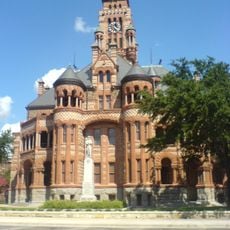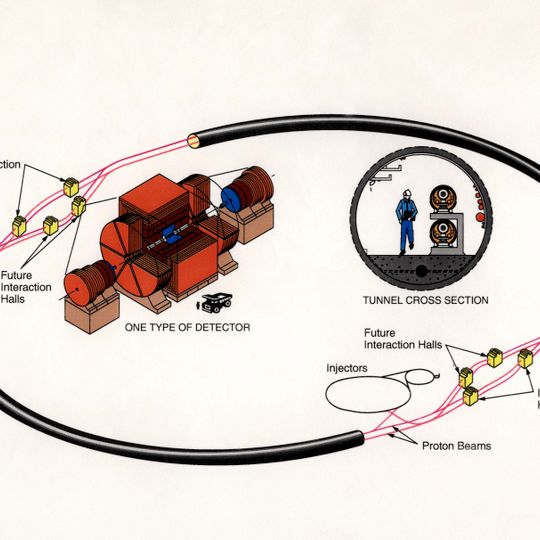
Superconducting Super Collider, Unfinished particle accelerator complex in Waxahachie, Texas, United States.
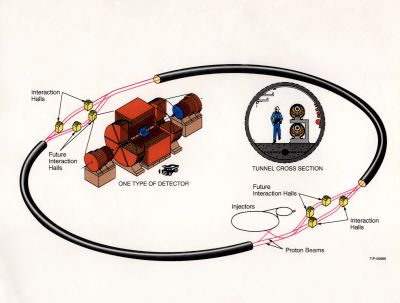
The Superconducting Super Collider was an underground facility with a tunnel network designed to accelerate proton beams to extreme energies for collision experiments. The project relied on advanced superconducting technology and would have become one of the world's largest scientific infrastructure installations.
The project was approved in 1987 to advance particle physics research on an unprecedented scale but was halted in 1993. The construction of superconducting magnets and tunnel excavation represented some of the most ambitious technical challenges of that era.
The facility represented American ambitions in particle physics research, aiming to maintain national leadership in understanding fundamental aspects of matter and energy.
The site is located near Waxahachie, Texas, where portions of the excavated tunnel structure remain underground. Those interested in learning more can check local museums or contact regional tourism resources for information about the project and its scientific context.
The project was technically so demanding that it tested the limits of engineering capabilities at the time and advanced understanding of large-scale superconducting technology. The decision to cancel it set a precedent for reshaping scientific investment priorities in the early 1990s.
The community of curious travelers
AroundUs brings together thousands of curated places, local tips, and hidden gems, enriched daily by 91,872 contributors worldwide.