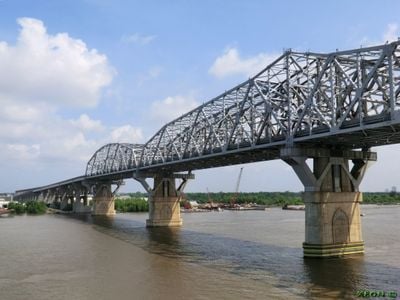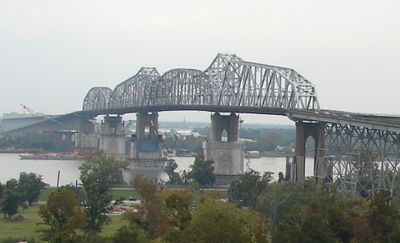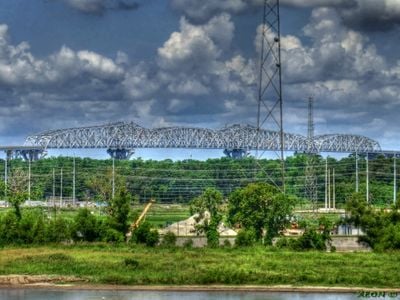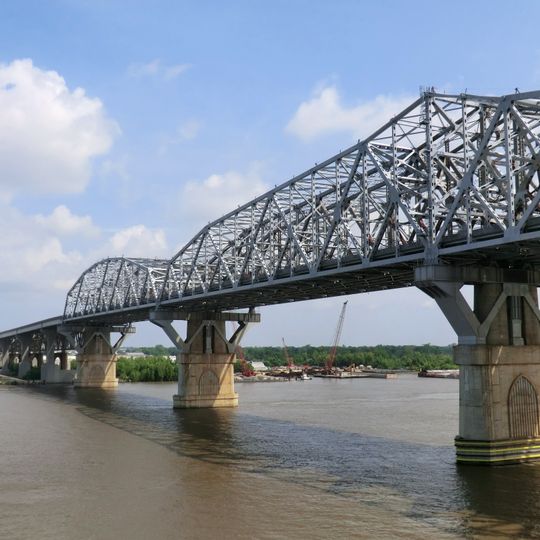
Huey P. Long Bridge, Steel cantilever truss bridge over the Mississippi in Jefferson Parish, Louisiana, United States
The Huey P. Long Bridge is a cantilevered steel through-truss crossing the Mississippi at river mile 106.1, several miles upriver from New Orleans, between Elmwood on the east bank and Bridge City on the west. Its deck carries two railroad tracks flanked by three lanes of US 90 in each direction. The widest clear span measures 790 feet, the three other spans 530 feet each, and the river crossing totals about 2,400 feet, with 152.9 feet of clearance above the water.
The Southern Pacific proposed a high-level crossing as early as 1892, but financing failed. Construction finally began on December 31, 1932, after bonds were guaranteed by the Southern Pacific, the City of New Orleans and the State of Louisiana. The bridge opened in December 1935, the first Mississippi River span in Louisiana and the 29th along the river.
The bridge is named for Huey P. Long, the Louisiana governor assassinated in September 1935, months before the span opened; the state named it in his memory. Its railfan following comes from the twin tracks running down the centre of the truss, flanked by the road lanes, a mixed rail-and-highway layout now rare among American river bridges.
The structure carries both rail and road traffic, with trains passing through occasionally and causing brief delays. A 2013 expansion brought wider lanes and shoulders for improved safety on US 90.
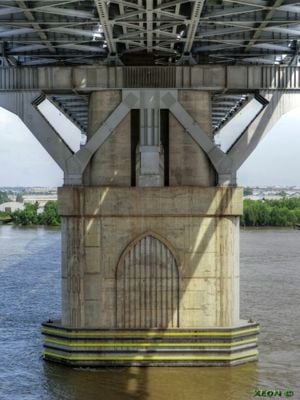
The main piers rest on fine sand 160 to 170 feet (49 to 52 m) below Mean Gulf Level, because bedrock lies about 1,000 feet down. Soil specialist Karl von Terzaghi examined bore samples from the site in 1926 and recommended sinking the foundations to that depth, where only their own weight and friction hold them. Contractor Siems-Helmers used reinforced-concrete caissons up to 20 by 30 m, dewatered inside cofferdams.
The community of curious travelers
AroundUs brings together thousands of curated places, local tips, and hidden gems, enriched daily by 92,808 contributors worldwide.