Ibirapuera Park, Urban park in Vila Mariana district, São Paulo, Brazil.
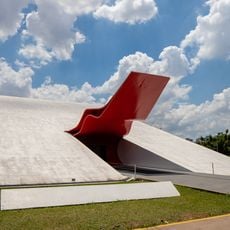
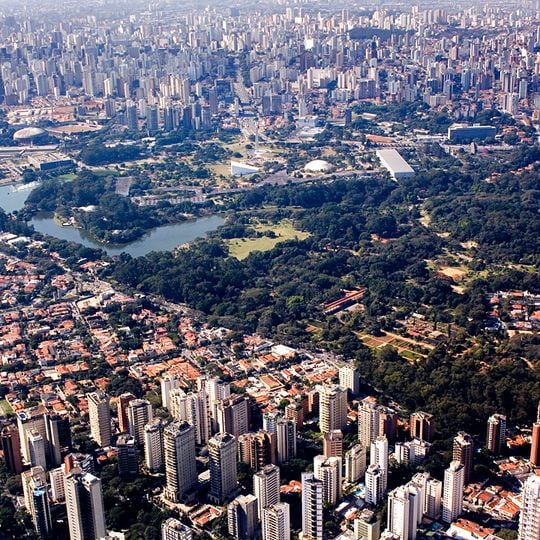
Ibirapuera Park is a 158-hectare urban park in Vila Mariana, São Paulo, bounded by Avenida Pedro Álvares Cabral, Avenida República do Líbano and Avenida IV Centenário. Its layout combines large lawns and a wooded area around an irregular lake with buildings designed by Oscar Niemeyer, including pavilions, an auditorium and a marquee. The gardens were planted by agronomist Otávio Augusto Teixeira Mendes after a concept by Roberto Burle Marx.
The park opened in 1954 to mark São Paulo's 400th anniversary, showcasing modernist buildings designed by Oscar Niemeyer. The design transformed swampy land into a public space that became a symbol of Brazil's urban modernization during the mid-20th century.
The name Ibirapuera comes from the Tupi language and means "old trees" (ybyrá, trees; pûer, old), not "rotten wood". The Japanese Pavilion, inspired by the Katsura Palace, was built in Japan and shipped to Brazil for the city's 400th anniversary in 1954. Since 2000, a Sabesp flotation station has treated water from the Sapateiro stream before it reaches the lakes.
The park opens daily from 5 AM to 11 PM through multiple entrance gates distributed around the grounds. The metro station AACD-Servidor sits about 15 minutes on foot from Gate 5, while other gates are closer to different bus routes.
The Japanese Pavilion, modelled on Kyoto's Katsura Palace, was built in Japan and shipped to Brazil for the city's 400th anniversary in 1954. The park's name comes from Tupi ybyrapûera, "old trees", after the swampy ground where Manequinho Lopes planted hundreds of Australian eucalyptus in 1927 to drain the soil.
The community of curious travelers
AroundUs brings together thousands of curated places, local tips, and hidden gems, enriched daily by 92,749 contributors worldwide.