Cimetière marin de Saint-Paul, Coastal cemetery in Saint-Paul, Réunion Island, France.
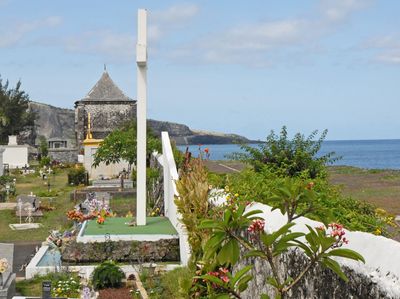
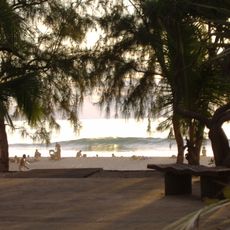
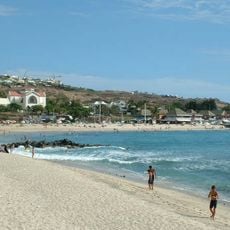
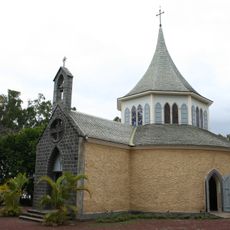
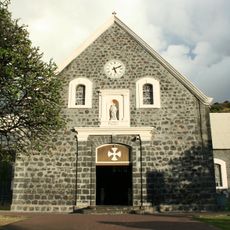
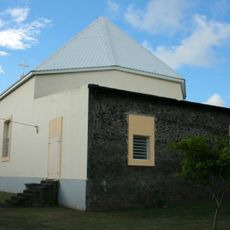
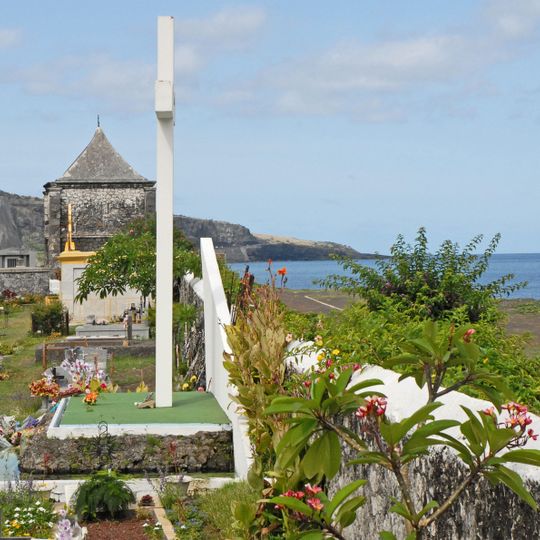
Cimetière marin de Saint-Paul is a walled burial ground on the edge of the Indian Ocean, overlooking a black sand beach in the bay of Saint-Paul. Its alleys are lined with coconut palms and frangipani trees, and beds of crotons grow between the graves. A tall white cross with a plain shaft stands on a green slab atop a base of dark rough stones, with a grey stone chapel with a pyramidal roof behind it.
Established in 1788, the cemetery contains graves of early French settlers, pirates, sailors, and merchants who shaped Réunion Island's colonial past. The burials document the arrival and settlement of different groups who made the island their home.
The name cimetière marin refers not to sailors but to the cemetery's open position facing the Indian Ocean. Leconte de Lisle, born in Saint-Paul in 1818, was reburied here in 1977 from Montparnasse, as wished in his poems "Le Manchy" and "Si l'Aurore". The painter Arthur Grimaud (1784–1869) and the poet Eugène Dayot (1810–1852) also lie here.
The cemetery lies on the bay shore of Saint-Paul, above a black sand beach, with the Chaussée Royale running alongside it. The grounds are flat and the paths are lined with palms and frangipani, so the graves and the chapel are easy to reach on foot. The site is open to the sea, and the white cross on its stone base stands near the entrance area.
Pirate Olivier Levasseur, executed in 1730, allegedly threw a cryptogram into the crowd before his death that might reveal the location of his hidden treasure. This story has drawn treasure hunters for centuries trying to crack the puzzle.
The community of curious travelers
AroundUs brings together thousands of curated places, local tips, and hidden gems, enriched daily by 93,816 contributors worldwide.