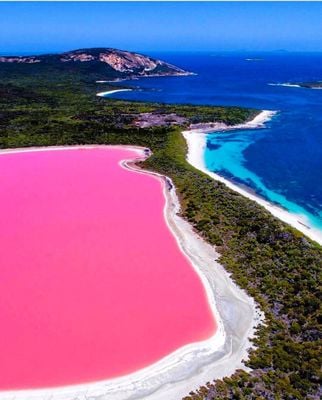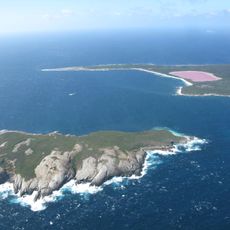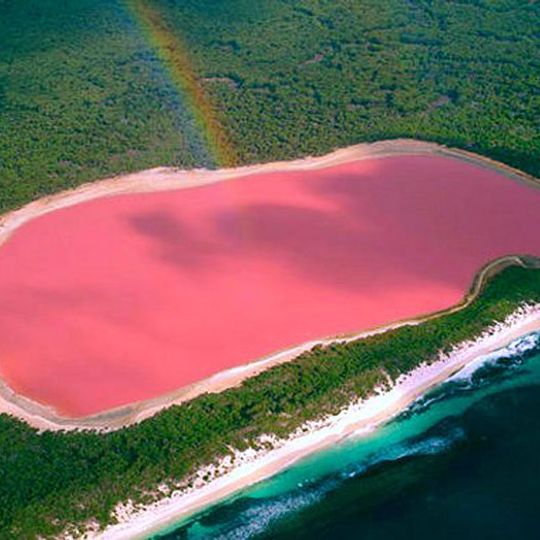
Lake Hillier, Salt lake on Middle Island, Recherche Archipelago, Western Australia
This body of water measures 600 meters (1970 feet) long and 250 meters (820 feet) wide, displaying rose-colored water that contrasts sharply with the surrounding dense paperbark and eucalyptus forest and the blue waters of the Southern Ocean beyond.
Matthew Flinders's expedition reached Middle Island on 15 January 1802, and his journal entries are the first written record of the lake; he named it after William Hillier, a crew member of HMS Investigator who died of dysentery on 20 May 1803 before the ship left the island. In 1889 Edward Andrews moved onto the island with his two sons to work the salt deposits, leaving after about a year; the mining failed partly because the salt was toxic for consumption.
Aboriginal communities knew of this body of water long before colonial settlement, understanding its place within the island ecosystems of the Recherche Archipelago and the natural features defining this remote coastal region.
Visitors can observe it through daily scenic flights from Esperance Airport, as Middle Island remains uninhabited and subject to access restrictions. Boat tours circumnavigate the island without landing, while charter flights provide optimal viewing conditions from above.
Dunaliella salina microalgae and halophilic bacteria generate the persistent coloration that remains evident even in extracted water samples. Scientists continue investigating the precise combination of organisms responsible for maintaining this unusual permanent hue throughout the year.
The community of curious travelers
AroundUs brings together thousands of curated places, local tips, and hidden gems, enriched daily by 92,304 contributors worldwide.