Mundrabilla, Iron meteorite in Nullarbor Plain, Western Australia.
Mundrabilla is an iron meteorite from the Nullarbor Plain, found as two large masses 180 metres apart in clayey soil, surrounded by many small fragments. The main mass, Mundrabilla I, weighs 12.4 tonnes and is kept at the Western Australian Museum; Mundrabilla II weighed 5.44 tonnes before being shipped to Germany for cutting. The metal is 65–75% iron-nickel with about 35% by volume troilite, plus graphite and silicates.
Harry Kent, a camel foreman on the transcontinental railway survey, found the first 112 g fragment at Premier Downs in 1911. In April 1966 geologists R. B. Wilson and A. M. Cooney found the two large masses, 12.4 and 5.44 tonnes, lying 180 m apart. The main mass is held at the Western Australian Museum.
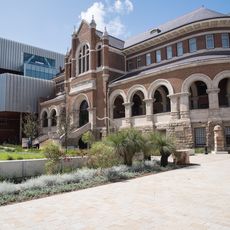
The Western Australian Museum maintains the largest fragment, making it accessible for scientific research and public education.
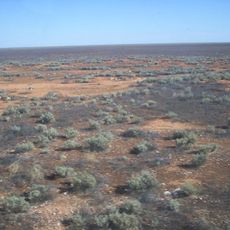
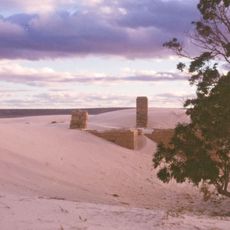
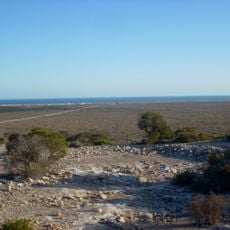
The find sites lie in the Nullarbor Plain near Mundrabilla Siding on the Trans Australian Railway, about 16 km north of the siding for the 1965 fragments. The two large masses were found 180 m apart in clayey soil within slight depressions, so the ground can soften after rain. The main mass is held at the Western Australian Museum in Perth, and a 3.5-tonne piece is displayed at the Museum of the Great Southern in Albany.
Researchers detected traces of superconductivity in the main mass, suggesting that naturally occurring superconductors might exist. This unexpected property makes the material interesting for material science and potential technical applications.
The community of curious travelers
AroundUs brings together thousands of curated places, local tips, and hidden gems, enriched daily by 94,047 contributors worldwide.