Neill-Cochran House, Greek Revival mansion in Austin, United States
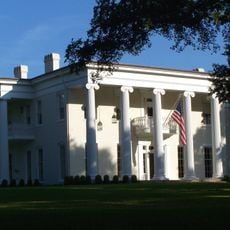
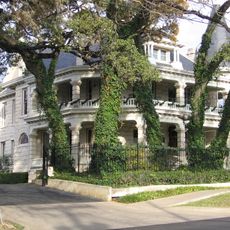
The Neill–Cochran House is a two-story Greek Revival home in north-central Austin, designed and built in 1855 by Abner Cook as a suburban estate on 17.5 acres. It has prominent Doric columns and Cook's signature "sheaf of wheat" balusters. A two-story building behind the main house is believed to be Austin's last remaining recognizable slave quarters.
Abner Cook designed and built the house in 1855 for Washington and Mary Hill, who never occupied it. In 1856 it was leased as the first home of the Texas Institute for the Blind. After the Civil War, Federal troops turned it into a hospital; George Armstrong Custer was stationed in Austin during Reconstruction. Colonel Andrew Neill bought it in 1876, and Judge Thomas Beauford Cochran purchased it in 1895.
The two-story building behind the main house is believed to be Austin's last remaining recognizable slave quarters. The house was built in 1855 for Washington and Mary Hill, who never occupied it; in 1856 it was leased as the first home of the Texas Institute for the Blind. The NSCDA has operated it as a museum since 1958.
The house can be visited Wednesday through Sunday and is normally explored through guided tours that cover both the main rooms and the preserved outbuildings. It helps to check ahead whether special tours of the slave quarters are scheduled, as these provide additional details about the lives of those who lived there.
The property was converted into a hospital by Colonel Custer, who later became famous at the Battle of the Little Bighorn, during the Civil War. This dual historical connection ties the local town story to larger national events.
The community of curious travelers
AroundUs brings together thousands of curated places, local tips, and hidden gems, enriched daily by 94,158 contributors worldwide.