Morro Castle, Fortress at Havana harbor entrance, Cuba
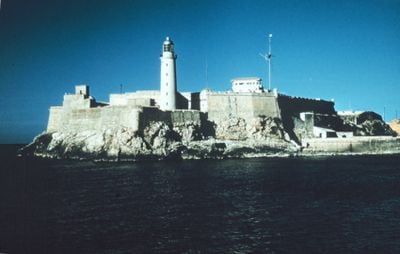
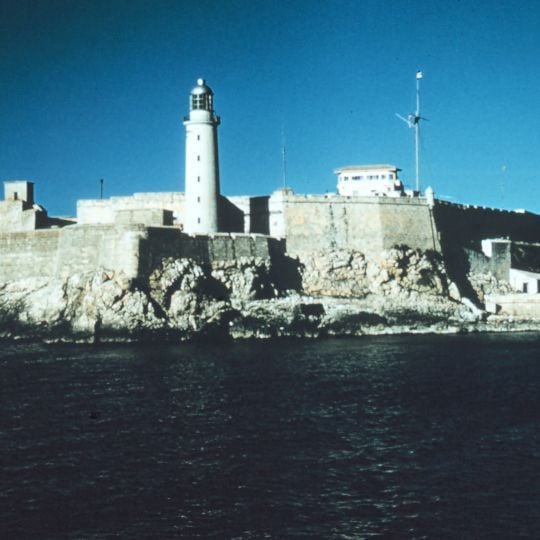
The Castillo de los Tres Reyes del Morro stands on a rocky promontory at the entrance to Havana harbor, opposite Old Havana. Its light gray stone walls have a crenellated top edge, and a tall cylindrical white lighthouse with a dark rounded top rises from the left-center of the fortress. To the right of the lighthouse sits a low rectangular building with a flat roof and small windows, and a thin mast with a wind gauge stands nearby.
Designed by the Italian engineer Battista Antonelli (1547–1616), the fortress was built from 1589 to guard the entrance to Havana harbor against raids. It first saw action in 1762 under Luis Vicente de Velasco e Isla, when a British expedition under Lord Albemarle landed at Cojimar and mined one of its bastions. Captured that year, it returned to Spain under the Treaty of Paris in 1763 and remained the harbor's primary defence until La Cabaña was completed in 1774.
The name comes from the Spanish morro, a rock visible from the sea that served as a navigational landmark. The fortress is part of the Old Havana World Heritage Site, inscribed in 1982. Its design is attributed to the Italian engineer Battista Antonelli.
The fortress stands on a promontory across the harbor from Old Havana, so it is reached by crossing the bay rather than on foot from the old town. The lighthouse and the low building with small windows sit on the seaward side, while the crenellated walls rest directly on pale gray rock. Paths between the bastions are uneven stone.
The chain, called the boom defence, ran from El Morro across the water to the fort at La Punta, closing the harbor entrance. The Spanish word morro refers to a rock visible from the sea, and the promontory served as a navigational landmark for ships approaching Havana.
The community of curious travelers
AroundUs brings together thousands of curated places, local tips, and hidden gems, enriched daily by 94,114 contributors worldwide.