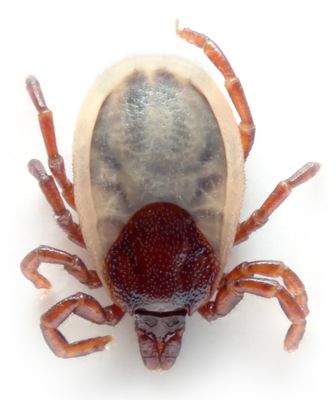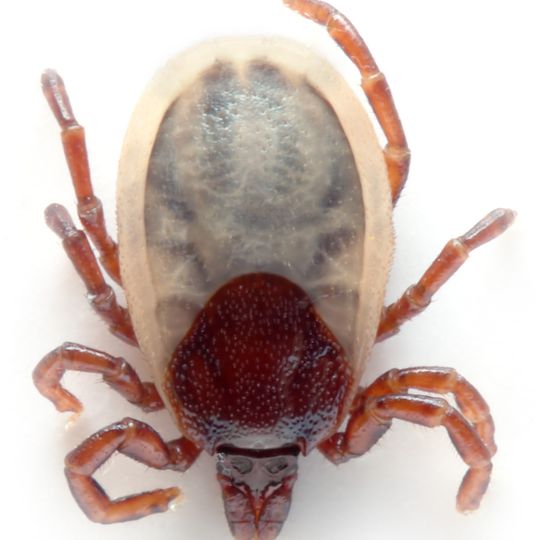
U.S. National Tick Collection, Scientific collection at Georgia Southern University, United States
The U.S. National Tick Collection is a zoological research collection owned by the Smithsonian Institution and held on permanent loan at Georgia Southern University in Statesboro, Georgia, under the university's Institute of Arthropodology and Parasitology. It holds more than one million ticks in all developmental stages, over 125,000 inventory lots and 850 species, making it probably the largest tick collection in the world. Specimens are freeze-dried, bottled and coated to show clearly under a microscope.
The collection began with Robert A. Cooley's taxonomic work on ticks at the Montana State College and the Rocky Mountain Laboratory in Hamilton, Montana, where it grew through exchanges with colleagues in South Africa and the United Kingdom. In 1983 the Rocky Mountain Laboratory's tick collection was donated to the Smithsonian Institution, forming the core of the United States Tick Collection under curator James E. Keirans. A 1990 agreement with Georgia Southern University brought it to Statesboro as a permanent loan; Lorenza Beati became curator in 2011.
The collection is used by researchers who study how ticks relate to human and animal diseases. For anyone working in parasitology or public health, it serves as a hands-on reference that connects field observations to laboratory work.
The collection is not open to the general public but can be browsed online through Georgia Southern University's Digital Commons portal. Anyone wishing to access the physical specimens directly should contact the university in advance.
The collection offers an interactive identification tool focused on hard tick species found in the eastern United States, designed for use by both researchers and citizen scientists. It is one of the few publicly available digital tools of its kind in the country.
The community of curious travelers
AroundUs brings together thousands of curated places, local tips, and hidden gems, enriched daily by 92,715 contributors worldwide.