Lumber River, Natural watercourse in south-central North Carolina, United States.
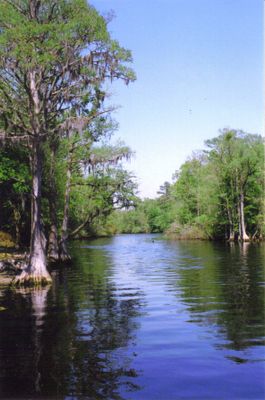
The Lumber River runs 133 miles (214 km) through the flat Coastal Plain of south-central North Carolina, from the Scotland County-Hoke County line to the South Carolina border. It is a blackwater river, its dark, acidic water coloured by tannins from cypress and black gum swamps, and it meanders in tight loops and oxbows along its whole course. Below it lies Lumber River State Park; past the state line it joins the Little Pee Dee River.
English surveyors first charted the river as Drowning Creek, a name still used for its headwater stream. In 1749 British colonial records listed it as a branch of the Little Pee Dee River. The North Carolina legislature renamed it Lumber in 1809, replacing the older name with one tied to the timber trade that floated 100-foot logs to Georgetown, South Carolina.
Archaeological excavations along the river uncovered Native American artifacts, including a dugout canoe dating back more than 1,025 years.
The Lumber River is a 133-mile waterway; the stretch from the Scotland County–Hoke County line downstream is the designated Lumber River, and the last 25 river kilometres lie in South Carolina. Lumber River State Park sits on the lower course in North Carolina. The river meanders heavily, with many tight bends and oxbow channels, so plan for slow going.
The dugout canoe recovered from the river banks is estimated at over 1,025 years old and is displayed at the Native American Resource Center at the University of North Carolina at Pembroke. Archaeologists have recorded 429 sites in Robeson County alone, spanning Paleo-Indian to historic periods.
The community of curious travelers
AroundUs brings together thousands of curated places, local tips, and hidden gems, enriched daily by 92,922 contributors worldwide.