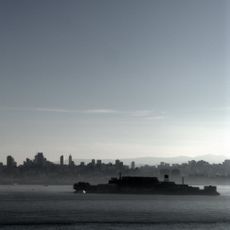
Angel Island Immigration Station, Immigration processing center in San Francisco Bay, United States.
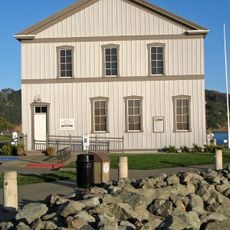
Angel Island Immigration Station is a two-story building on a grassy slope, with a tan-yellow lower level, a white upper level, evenly spaced rectangular windows, and a dark shingled roof with small white chimneys. A covered entryway with stairs and a white-railed ramp extends to the right. Inside, a long dormitory room has dark wooden walls and ceiling, a concrete floor, and two rows of narrow metal bunk beds with wire-mesh supports facing each other across a central aisle.
The station opened on January 21, 1910, after construction began in 1905 on land transferred from the War Department. It processed immigrants from 84 countries, with Chinese and then Japanese arrivals forming the largest groups. The administration building burned down in August 1940, and the station closed; the Chinese Exclusion Act was repealed in 1943.
Chinese detainees carved over 200 poems into the wooden walls of their sleeping quarters, leaving verses about homesickness, fear, and hope. These inscriptions remain visible today and form a rare direct voice of the people who waited here for months or years for an answer.
The facility today is a museum located on an island reached by ferry. The tour leads through the dormitories, hospital, and administrative rooms and shows the process people went through.
European travelers went through inspections on board their ship and were usually allowed to leave immediately, while Asian immigrants were brought to the island. Some people remained here for weeks or months until their papers were reviewed.
The community of curious travelers
AroundUs brings together thousands of curated places, local tips, and hidden gems, enriched daily by 93,367 contributors worldwide.