Union Bay Natural Area, Protected natural area near Lake Washington, United States.
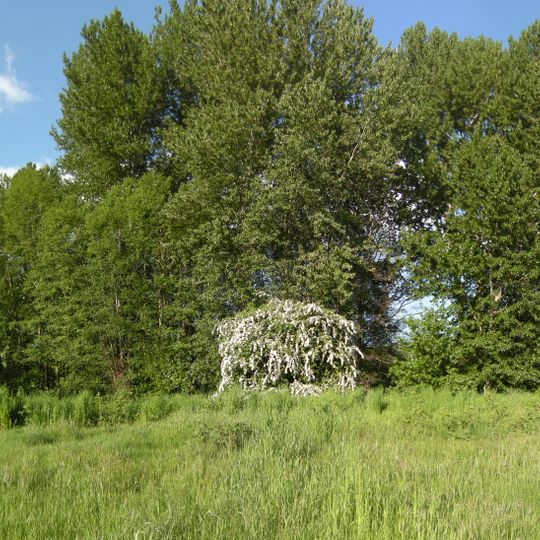
Union Bay Natural Area is the restored remainder of the filled Union Bay Marsh at the east end of the University of Washington campus, south of NE 45th Street and west of Laurelhurst. It holds small grasslands, permanent and seasonal ponds, woods, sample prairie, marshland and a stretch of Lake Washington shoreline. The Drainage Canal, locally called University Slough, carries Ravenna Creek through the site to the bay, passing southeast of the Husky Ballpark grandstand.
The site was a City of Seattle landfill from 1911 to 1966, known as the Montlake, University or Ravenna dump, and received residential and industrial solid waste. It was closed and covered with two feet of clean soil five years later. The opening of the Montlake Cut in 1916 had drained Union Bay Marsh, and the filled land later held University Village (1956), UW athletic fields and parking; the remainder became the Union Bay Natural Area.
Volunteers do much of the restoration work at Union Bay Natural Area, clearing invasive Himalayan blackberry (Rubus armeniacus) and field bindweed (Convolvulus arvensis) to bring the site closer to a natural state. The area is owned by the State of Washington and held under the University of Washington, which controls access; parts are open during park hours, while other sections are closed seasonally for habitat or species protection.
Access is controlled: parts of the area are open during park hours, while entry to other portions is discouraged, some seasonally, for habitat or species protection. The Drainage Canal, also called University Slough, runs from NE 45th Street south to Union Bay, passing between the driving range and IMA Sports Field 1 and ending southeast of the Husky Ballpark grandstand. Sturdy footwear helps on uneven ground.
The site's nickname, "the fill", recalls its past as the Montlake landfill, where the TV clown J. P. Patches was said to live from 1958 to 1981. Volunteers remove invasive Himalayan blackberry and field bindweed to restore the grounds.
The community of curious travelers
AroundUs brings together thousands of curated places, local tips, and hidden gems, enriched daily by 93,779 contributors worldwide.