Navajo Sandstone, Sandstone formation in Nevada, United States
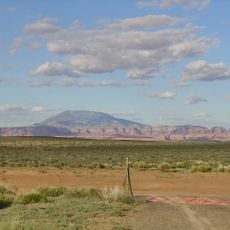
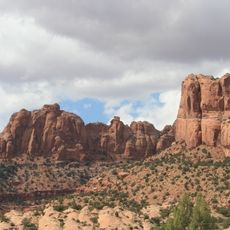
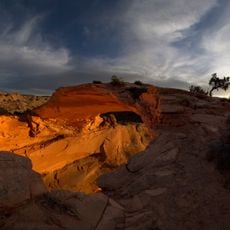
Navajo Sandstone is a geological formation of the Glen Canyon Group, found across southern Nevada, northern Arizona, northwest Colorado and Utah. It appears as white to light pink cliffs, cuestas, domes and bluffs, with meter-scale cross-bedding and rounded weathering. Iron oxides give many layers black, brown, crimson, orange, pink, gold and yellow tones.
Named for the 'Navajo Country' of the southwestern United States, the formation was first described by Gregory and Stone in 1917 as the uppermost unit of the La Plata Group. Baker reassigned it in 1936 as the upper formation of the Glen Canyon Group. A 2019 radioisotopic analysis dates it to the early Jurassic, beginning around 200–195 million years ago.
The formation is named for the "Navajo Country" of the southwestern United States, not for a type locality. Rockhounds know it for iron-oxide concretions called "Moqui marbles", which weather out of outcrops in south-central and southeastern Utah, especially in Grand Staircase–Escalante National Monument; they are linked to Hopi traditions concerning ancestor veneration.
You can observe the formations at multiple access points, particularly within national parks throughout the region. The best time to visit depends on your planned route and local weather conditions.
The formation preserves dinosaur tracks pressed into the stone, offering rare glimpses into prehistoric animal movement. These ancient footprints tell stories of creatures that walked across ancient sand dunes.
The community of curious travelers
AroundUs brings together thousands of curated places, local tips, and hidden gems, enriched daily by 93,195 contributors worldwide.