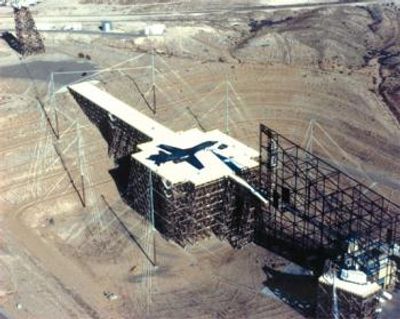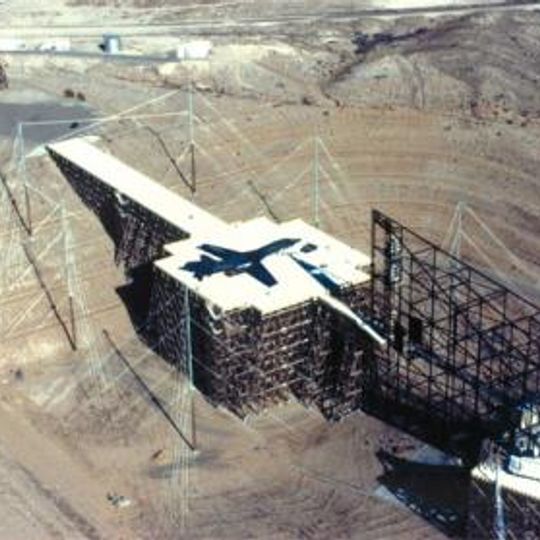
ATLAS-I, US Air Force electromagnetic pulse generation and testing apparatus in use from 1972-1980 at Sandia National Laboratories in Albuquerque, NM, US
ATLAS-I, also known as Trestle, is a laboratory facility in New Mexico built to test how aircraft systems could survive powerful electromagnetic pulses simulating nuclear effects. The structure features a massive wooden platform capable of holding the largest US Air Force bombers, a steel wedge-shaped transmission tower, and a shielded control building equipped with monitoring equipment and sensors.
Built during the Cold War, this facility was created to test whether aircraft systems could withstand electromagnetic pulses from nuclear explosions occurring high in the atmosphere. Scientists used Marx generators producing up to ten million volts to simulate such effects, helping make electronic equipment safer and contributing to advances in aerospace technology that remained influential for decades.
The site sits about a mile from Albuquerque airport near Kirtland Air Force Base and can be viewed from aircraft during approach or departure. Due to its military background, access to the grounds remains limited, but you can observe the wooden structure and its size from a distance.
The wooden Trestle structure is the world's largest of its kind, deliberately built from wood to avoid metal parts that would distort electromagnetic pulse measurements during testing. This innovative design choice enabled precise scientific experiments and remains a rare example of specialized Cold War technology standing openly in the desert landscape.
The community of curious travelers
AroundUs brings together thousands of curated places, local tips, and hidden gems, enriched daily by 91,862 contributors worldwide.