United States Air Force Academy Cadet Chapel, Military chapel at United States Air Force Academy, Colorado Springs, USA
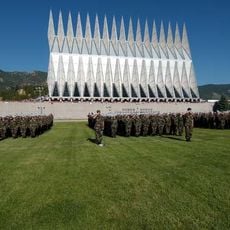
The United States Air Force Academy Cadet Chapel is a tubular steel frame of 100 identical tetrahedrons, each 75 feet long and weighing five tons, enclosed with aluminum panels. Its south facade has a wide granite stairway with steel railings and aluminum handrails leading to gold anodized aluminum doors. The chapel measures 150 feet high, 280 feet long, and 84 feet wide, with seventeen spires.
Designed by Walter Netsch of Skidmore, Owings and Merrill and built by Robert E. McKee, Inc., the chapel was completed in 1962; its design was controversial at first. It received the AIA Twenty-five Year Award in 1996 and, as part of the Cadet Area, was named a National Historic Landmark in 2004. It closed in September 2019 for a $158 million renovation after decades of water leaks; work is now scheduled to finish in May 2028.
Walter Netsch stacked the worship areas on two levels, inspired by the Sainte-Chapelle in France and the Basilica of San Francesco d'Assisi in Italy. The Protestant nave for 1,200 people occupies the upper floor; the Catholic and Jewish chapels and a Buddhist room sit beneath it, with an Islamic prayer room and meeting rooms below. Each space has its own entrance, so services can run at the same time. The pews end in carvings shaped like World War I airplane propellers.
The chapel closed in September 2019 for a $158 million renovation after decades of leaks damaged the main floor; updated signage at the site schedules completion for May 2028. The south facade is reached by a wide granite stairway with steel railings and aluminum handrails, rising one story to a landing with gold anodized aluminum doors. Each worship space has its own entrance, so services can run at the same time.
The chapel's seventeen spires were meant to number twenty-one; budget cuts removed four. The aluminum panels were fabricated in Missouri and shipped by rail to the site, and the tetrahedrons stand one foot apart, the gaps filled with one-inch-thick colored glass. Netsch's original rain gutters beneath the aluminum skin went unbuilt, so the seams were caulked instead.
The community of curious travelers
AroundUs brings together thousands of curated places, local tips, and hidden gems, enriched daily by 94,481 contributors worldwide.