Vore Buffalo Jump, Archaeological site in Crook County, Wyoming.
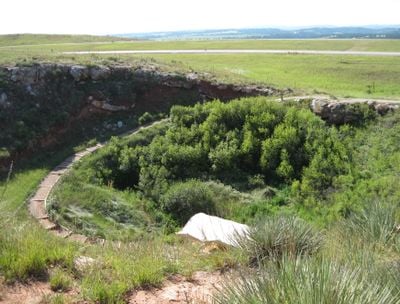
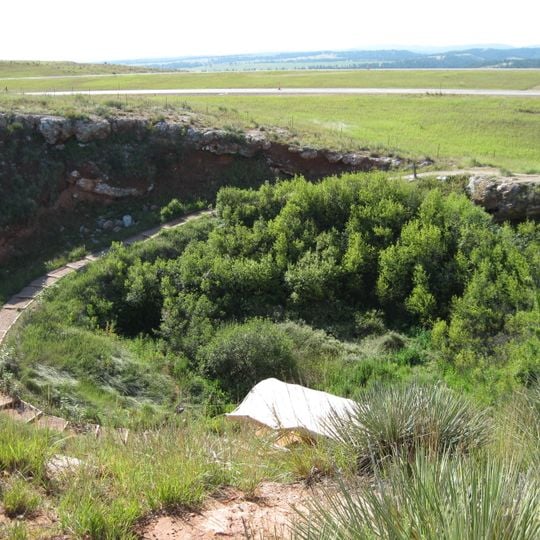
Vore Buffalo Jump is an archaeological site in Crook County, Wyoming, where erosion of gypsum soil opened a steep-sided pit about 40 feet deep and 200 feet in diameter. The exposed cliff face shows layered rock bands and grey boulders, with trees and shrubs along its base and a stone-paved footpath curving down to the bottom.
The Vore sinkhole was used as a bison kill and butchering site from about 1500 to 1800 AD. Lithic evidence suggests the Kiowa and Apache used it while migrating south toward the Texas–New Mexico region; later users included the Shoshone, Hidatsa, Crow and Cheyenne. The site was discovered during construction of Interstate 90 in the early 1970s, and the road was moved south. Dr. George Frison of the University of Wyoming investigated it in 1971 and 1972, and it was listed on the National Register of Historic Places in 1973.
Lithic evidence links the site to the Kiowa and Apache as they moved south toward their later homes in the Texas–New Mexico region; the Shoshone, Hidatsa, Crow and Cheyenne used it later. The Vore Buffalo Jump Foundation runs a small interpretive center with tours and 15 stations on Plains Indian culture, and visitors can look out over the pit from a lookout.
The site lies in a narrow strip between Interstate 90 and old US 14, with a small interpretive center built by the Vore Buffalo Jump Foundation. Visitors climb a lookout over the pit and follow a series of 15 stations explaining the site's natural and cultural history. The ground is uneven and shade is limited, so wear sturdy footwear.
Scientists estimate that roughly 95 percent of the site remains unexcavated beneath the ground, potentially containing up to 20,000 more buffalo skeletons. This makes it extraordinarily valuable for future archaeological study.
The community of curious travelers
AroundUs brings together thousands of curated places, local tips, and hidden gems, enriched daily by 92,782 contributors worldwide.