Redknife Formation, Geological formation in Northwest Territories, Canada
The Redknife Formation is a Devonian stratigraphic unit of the Western Canadian Sedimentary Basin, divided into the Jean Marie Member at its base and an upper unnamed shale unit. The Jean Marie Member consists of argillaceous, silty and dolomitic fossiliferous limestone, while the upper part is calcareous shale with silty limestone and siltstone interbeds. The upper shales reach a maximum thickness of 79 feet (20 m), the lower carbonates up to 15 feet.
The formation was first documented in 1962 along the Trout River and identified as a significant Late Devonian structure. It formed hundreds of millions of years ago when an ancient sea covered this region.
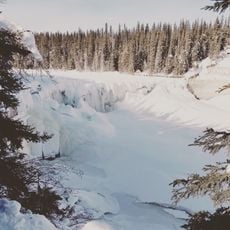
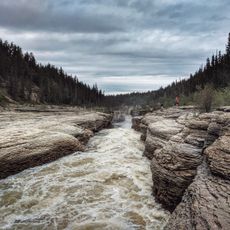
The formation's name comes from the Redknife River, a tributary of the Mackenzie River, and its Jean Marie Member is named for the Jean Marie River. Belyea and McLaren first described it in 1962 at Table Rock Rapids on the Trout River, north of Trout Lake.
The Jean Marie Member crops out south of the Mackenzie River between Kakisa and Blackstone River in the southern Northwest Territories, and the formation also lies in the subsurface of northeastern British Columbia and northwestern Alberta. The upper shales reach 79 feet (20 m) and the lower carbonates up to 15 feet. Gas is produced from the Jean Marie Member in the Greater Sierra field east of Fort Nelson, British Columbia.
The Jean Marie Member, the formation's base, was deposited during the Frasnian age and is named for the Jean Marie River. Its massive carbonates are thickest east of Fort Nelson and west of the Alberta border, and gas is produced from this member in the Greater Sierra field east of Fort Nelson, British Columbia.
The community of curious travelers
AroundUs brings together thousands of curated places, local tips, and hidden gems, enriched daily by 93,365 contributors worldwide.