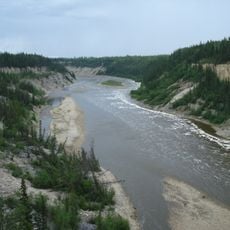
Horn River Formation, Shale formation in Northwest Territories, Canada
The Horn River Formation is a shale layer buried deep beneath the surface of the Northwest Territories in Canada. It is made of dark rock containing silica-rich material and limestone deposits that formed at the bottom of an ancient sea.
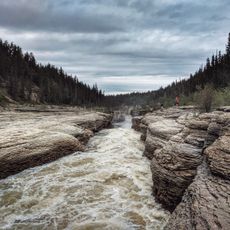
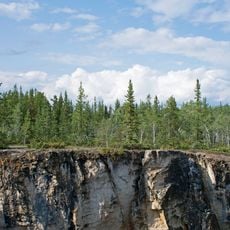
The formation was first described in 1922 by E.J. Whittaker, who studied rock outcrops along the banks of the Horn River. His work gave geologists an early foundation for understanding how this part of North America looked during the Devonian period.
The Horn River Formation is not something visitors can see directly, but it shapes how geologists think about the deep past of this part of Canada. It is used as a reference point when studying the Middle to Late Devonian period across the Western Canadian Sedimentary Basin.
The formation lies entirely underground and cannot be visited or seen in person. Anyone interested in learning more can consult geological reports and research from surveys carried out in the Northwest Territories.
The Horn River Formation is made up of three distinct layers, each with a different color and mineral mix. This variation shows that conditions on the ancient seafloor changed over time, making each layer a record of a different moment in geological history.
The community of curious travelers
AroundUs brings together thousands of curated places, local tips, and hidden gems, enriched daily by 91,374 contributors worldwide.