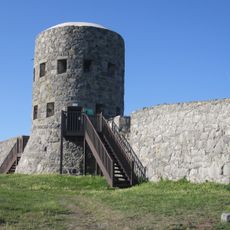
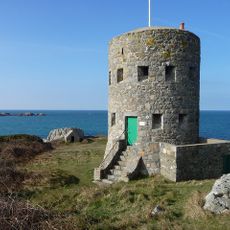
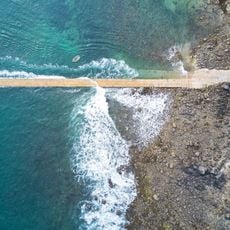
Les Casquets, Rock formation near Alderney, Guernsey
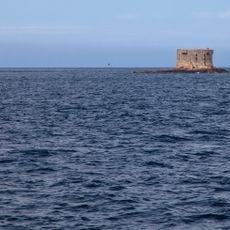
Les Casquets is a group of rocks 8 miles (13 km) northwest of Alderney, part of an underwater sandstone ridge whose other above-water outcrops are Burhou and Ortac. Little vegetation grows on them. The rocks are administered by the Bailiwick of Guernsey.
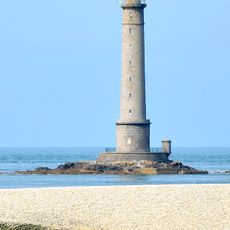
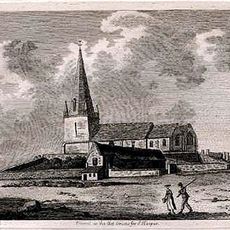
Three lighthouses were built on the rocks in 1724 to improve navigation through the English Channel. This construction marked the beginning of technological solutions for one of Europe's most hazardous sea passages.
Victor Hugo, living in exile on Guernsey, set the shipwreck of the Biscayan bark Matutina in 'L'Homme qui Rit' (1869) near Les Casquets. In the novel the vessel is spared by the rocks but sinks between Alderney and Ortac. Hugo also listed the names of the reefs between the Casquets and Alderney, from Sastériaux to Orbue.
Tidal streams around the rocks reach 6–7 knots on spring tides, and the area lacks landmarks, so approach only with local knowledge. The Casquets traffic separation scheme, monitored by CROSS Jobourg, routes shipping nearby. The lighthouse is automatic and controlled from Harwich; its foghorn sounds every 6 seconds and carries about 5 km.
The name may come from the French "casque", for the helmet-like shape of the rocks, or from "cascade", after the tidal surges around them. A map of about 1640 gives the Latin Casus Rupes, broken rocks, which may be a folk etymology. Swinburne's poem Les Casquets is based on the Houguez family, who lived on the rocks for 18 years.
The community of curious travelers
AroundUs brings together thousands of curated places, local tips, and hidden gems, enriched daily by 92,787 contributors worldwide.