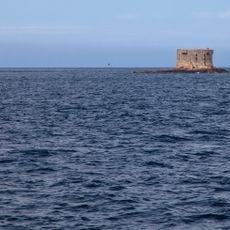
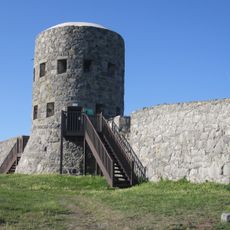
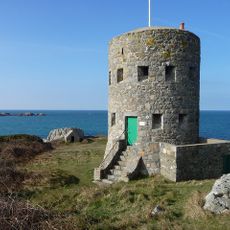
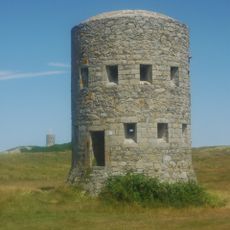
Casquets lighthouses, Lighthouse complex on Les Casquets rocks, Alderney, Channel Islands.
Casquets lighthouses comprise three stone towers built on the rocky Casquets rocks off Alderney in the Channel Islands. The north-west tower continues to function as the main navigation light for vessels passing through the English Channel.
Thomas Le Cocq built three stone towers on Les Casquets under a 61-year licence from Trinity House; they began operating with coal fires on 30 October 1724. His grandchildren's agent replaced the coal fires with oil lamps in copper and glass lanterns on 30 October 1779, cutting the keepers from seven to four. The lease reverted to Trinity House in 1785, and in 1790 each tower received parabolic reflectors and Argand lamps turned by a single clockwork mechanism linked by ropes and sheaves.
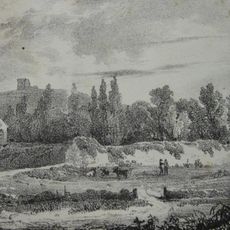
The towers were named St Peter's (north-west), St Thomas (south-west) and Dungeon (easternmost). Victor Hugo, exiled on Guernsey around 1860, drew the Casquets light in a dark, gloomy work now held at the Maison de Victor Hugo in Paris, and set a chapter of L'Homme qui rit here.
The lighthouses are located on isolated rocks and are only accessible by boat or helicopter from Alderney, so plan a sea tour in advance. Weather on the open water can shift quickly, so wear sturdy footwear and layered clothing suitable for changing conditions.
The three towers were not set in a triangle to look distinctive: the stone walls linking them enclosed a triangular compound for the keepers who lived on the rocks. The towers themselves were named St Peter's (north-west), St Thomas (south-west) and Dungeon (easternmost), and the west towers stood taller than the east one, though all three lights sat at the same height above the sea.
The community of curious travelers
AroundUs brings together thousands of curated places, local tips, and hidden gems, enriched daily by 94,850 contributors worldwide.