La Cotte de St Brelade, Prehistoric cave site in Saint Brelade, Jersey.
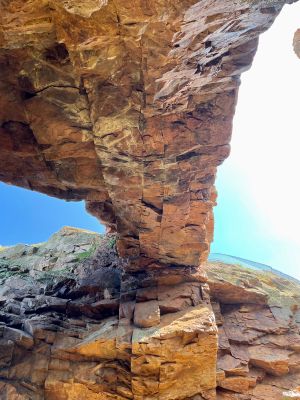
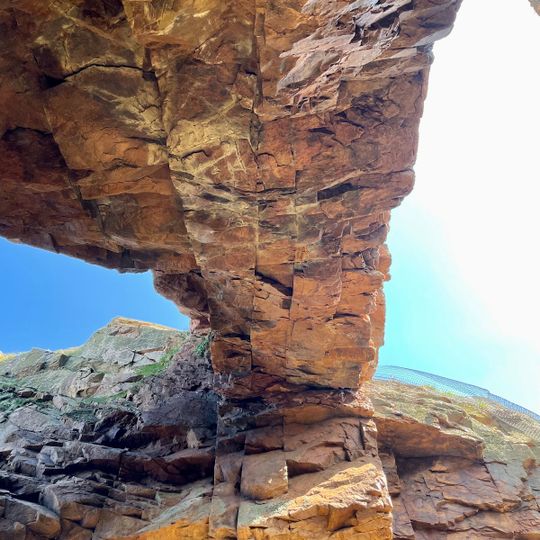
La Cotte de St Brelade is a granite headland in Saint Brélade, Jersey, holding two deep ravines that form part of a collapsed sea cave system. Its cleft opens between reddish-brown and grey rock faces fractured into angular blocks, with grass on the upper ledges and loose boulders sloping to the sand below. Excavations since 1910 uncovered over 40 m of deposits with up to 13 Neanderthal occupation episodes.
The cave served as a shelter for early humans during the middle stone age with evidence dating back approximately 238,000 years. This makes it one of the oldest known occupation sites in the Channel Islands region.
The site reveals how Neanderthals adapted to their coastal surroundings and organized their survival through hunting. The discovered tools and bones show their skill in processing large game and making shelter near the cliffs.
The site is best visited at low tide when the cave becomes accessible across the beach. Sturdy footwear is necessary as the terrain is rocky and uneven throughout the approach and surrounding area.
The idea that Neanderthals drove mammoths off the cliffs was proposed early on, but later analysis of the bone accumulations questioned it, suggesting the remains built up gradually over long, repeated occupations. The site also yielded eleven human teeth in 1910–1911, and a 2021 study found a mix of Neanderthal and Homo sapiens features in them.
The community of curious travelers
AroundUs brings together thousands of curated places, local tips, and hidden gems, enriched daily by 94,354 contributors worldwide.