Cenotaph of Rudolf IV, Medieval cenotaph in St. Stephen's Cathedral, Vienna, Austria.
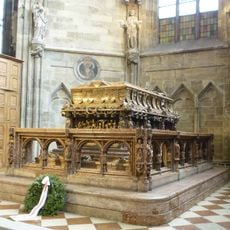
The Cenotaph of Rudolf IV is an empty tomb in St. Stephen's Cathedral, moved after World War II to the south side of the polygonal apse of the Frauenchor. Its cover is red Adneter marble, carved with over-life-size figures of Rudolf and his wife Katharina, heads on cushions, eyes open, two lions at their feet. The base has Gothic arches that once held eight mourning figures per long side, now lost.
Rudolf IV died in Milan on 27 July 1365, aged 25; his body was treated with red wine, sewn into a black ox hide and carried over the Alps to Vienna. The cenotaph was probably set up during his lifetime and first stood in the Albertine Choir before the high altar, near the entrance to the ducal crypt. In 1493, after Emperor Frederick III's death, it was moved to the south side of the north choir, and after World War II to the south side of the Frauenchor polygonal apse.
The inscription on Rudolf's slab is written in the Alphabetum Kaldeorum, a medieval cipher whose invention is attributed to Rudolf himself. It gives only his name and title, perhaps to show his fondness for the secret script. The small mourning figures of monks and university representatives that once stood under the Gothic arches of the base are lost.
You can view this memorial during the cathedral's regular opening hours while exploring the interior space. Dress respectfully since this is a sacred place, and allow time to examine the carved details up close and read the inscriptions on the stone.
The tomb lid shows Rudolf and his wife Katharina with open eyes and lions at their feet, imagery meant to signal resurrection rather than death. The slab's inscription is written in the Alphabetum Kaldeorum, a medieval cipher attributed to Rudolf himself, and gives only his name and title.
The community of curious travelers
AroundUs brings together thousands of curated places, local tips, and hidden gems, enriched daily by 93,044 contributors worldwide.