Prince Eugene Chapel, Gothic chapel in St. Stephen's Cathedral, Vienna, Austria
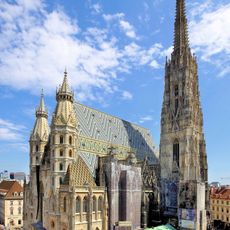
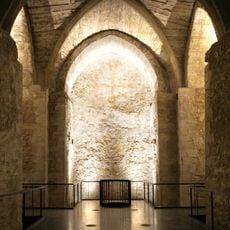
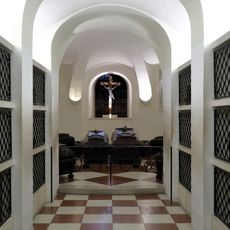
Prince Eugene Chapel is a Gothic chapel built in the 14th century against the left Heidenturm at the north corner of St. Stephen's Cathedral's portal facade. Its interior was remodeled in the 18th and 19th centuries; a large fresco by Johann Nepomuk Ender from 1853 surrounds the Gothic crucifix above the altar, and ten neo-Gothic statues stand under stone canopies on the columns. A Baroque iron grille bearing the Savoy-Liechtenstein coats of arms closes the chapel.
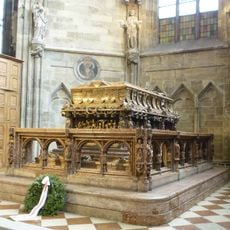
The chapel was built in the 14th century in Gothic style against the left Heidenturm as one of four west chapels from Duke Rudolf IV's expansion of St. Stephen's Cathedral; its walls were finished in his lifetime. In 1736 Prince Eugene of Savoy was buried in the crypt beneath the chapel, which had been created from 1729 for the House of Savoy. His elaborate epitaph, with a sham sarcophagus showing a Turkish battle relief made by goldsmith Joseph Wurschbauer in 1754/59, stands in a wall niche of the tower.
The chapel's name honours Prince Eugene of Savoy, buried in the crypt in 1736. The epitaph against the south wall of the Heidenturm, made by goldsmith Joseph Wurschbauer in 1754/59, shows a relief of a Turkish battle and the coats of arms of Savoy and Liechtenstein. A plaque lists Austrian priests killed in both world wars.
The chapel is accessible as part of visiting St. Stephen's Cathedral through the main entrance. It helps to grab a map to locate it within the large building and allow time to explore the space properly.
The chapel's iron grille carries the coats of arms of the Savoy and Liechtenstein families, and the late-Gothic crucifix above the altar has hair and beard made of real hair, which gave rise to the popular belief that God's hair grows.
The community of curious travelers
AroundUs brings together thousands of curated places, local tips, and hidden gems, enriched daily by 94,598 contributors worldwide.