St. Pölten dome, Romanesque cathedral in St. Pölten, Austria
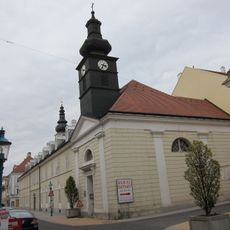
St. Pölten Cathedral is a Baroque-appearing church with a well-preserved late Romanesque core. Its massive south tower, topped by a double onion dome and lanterns, rises above a cream-plastered facade with a red tiled roof. The west front has the main portal with a scrolled gable, flanked by statues of Saint Hippolytus and Saint Augustine. Inside, the high altar, built from 1722 by Jakob Prandtauer, holds Tobias Pock's 1658 painting of the Assumption.
A Benedictine monastery existed here from around 790, and the first documentary reference dates to 976 under Emperor Otto II. Around 1150 the church was rebuilt with three naves and two west towers; after a fire it was rebuilt between 1267 and 1280, and in 1228 Bishop Gebhard dedicated it to the Assumption of Mary. After the fire of 1621, Jakob Prandtauer and Joseph Munggenast baroquised the interior, and in 1785 it became the cathedral of the new Diocese of St. Pölten.
The cathedral's name, Dom Mariä Himmelfahrt, refers to the Assumption of Mary, the dedication Bishop Gebhard gave the church in 1228. The city itself takes its name from Saint Hippolytus, whose relics the Benedictine monks brought here around 790. Statues of Hippolytus and Augustine flank the west portal.
Enter through the main entrance on Domplatz and expect to encounter original stone floors and steps inside. Check opening times beforehand, as religious services may limit visitor access during certain hours.
The south tower's two-tiered onion dome and lanterns are Baroque additions from the 17th-century remodelling; the late Romanesque apse and south facade survive from the 1267–1280 rebuild. The north tower was demolished after the town fire of 1512 and never rebuilt, so the church has a single tower today.
The community of curious travelers
AroundUs brings together thousands of curated places, local tips, and hidden gems, enriched daily by 93,586 contributors worldwide.