Falkenstein Castle, Medieval castle ruins in Weinviertel, Lower Austria.
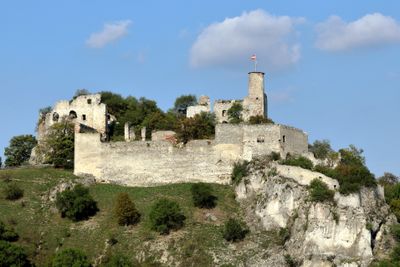
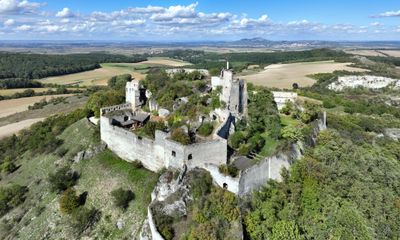
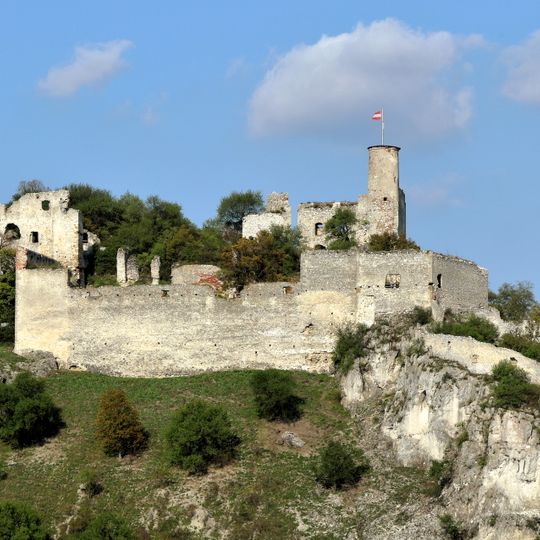
Falkenstein Castle is a ruined hilltop castle on a limestone cliff at 415 metres in the northern Weinviertel. Its oldest part, a long pale grey and tan wall with rectangular openings, runs across the lower section; a cylindrical tower with a flat top and a red and white flag stands to the upper right. Jagged wall sections with square windows rise to the upper left, and two attached square towers, the taller with a thin spire, stand high on the right above an irregular courtyard with low buildings.
The fortress was founded around 1050 as a border defense for the Holy Roman Empire and to monitor territories to the east. Over later centuries, the structure was rebuilt and modified several times before eventually losing its military importance and falling into decline.
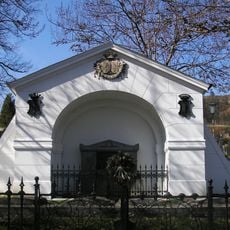
In June 2011 a museum called the Täufergwölb opened in the castle's historic vault, recalling the 150 Anabaptists imprisoned here in 1539 before being sent to Trieste to be sold as galley slaves. Among them was the Hutterite chronicler Kaspar Braitmichel, who escaped. A scale replica of a historic galley hull stands in the castle courtyard.
The site is accessible on foot with information signs that help visitors explore the history independently. It is helpful to wear sturdy footwear since the terrain is uneven and stairs lead to the upper areas.
The fortress incorporates naturally occurring caves as part of its structure, an unusual feature showing how builders incorporated the landscape itself into their design. Many visitors focus on the stone walls and overlook these underground spaces completely.
The community of curious travelers
AroundUs brings together thousands of curated places, local tips, and hidden gems, enriched daily by 92,883 contributors worldwide.