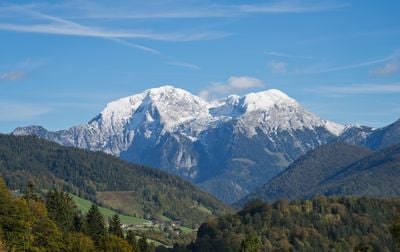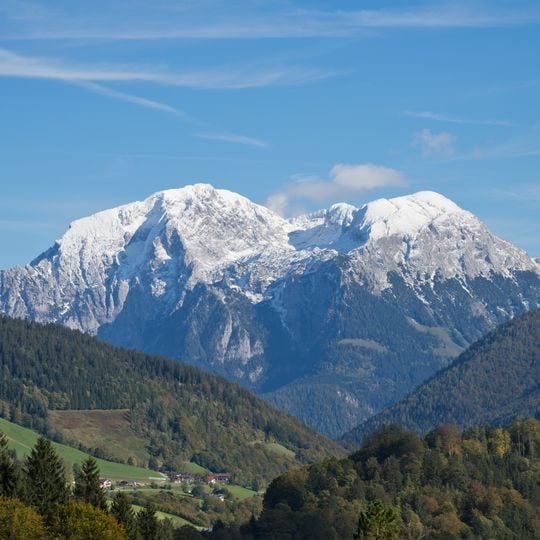
Hoher Göll, Alpine peak in Berchtesgaden Alps, Germany and Austria.
Hoher Göll is an alpine peak in the Berchtesgaden Alps located between Bavaria and Austria. The mountain can be reached via multiple climbing routes and forms the central feature of the Göll massif in this region.
The Salzburg theology student Valentin Stanig reached the summit in 1800 from the Eckerfirst, having climbed the Großglockner and Watzmann the month before. He carried out survey work on top; his figure of 7,812 Parisian feet (2,538 m) was published by Franz Michael Vierthaler in the Salzburger Intelligenzblatt on 13 September 1800. On 12 July 1885, 31 young men carried the first iron summit cross up overnight on an eight-hour march and set it in the morning.
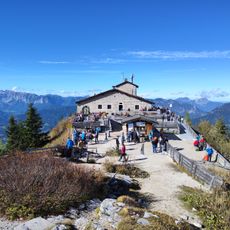
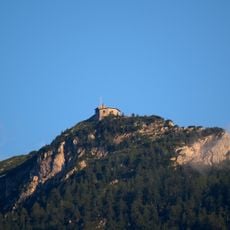
The Hoher Göll's name appears in the local landscape: the Salzach valley town of Golling an der Salzach sits at the base of the massif, where the Lammer joins the Salzach. The peak is linked northward by the Mannlgrat ridge to the Kehlstein spur, whose 1,834 m summit carries the Kehlsteinhaus, a former Nazi retreat now run as a restaurant.
The Salzburger Steig from the Purtschellerhaus takes about 2½ hours via the Schuster-Route or the Kamin before the Rauchfang; the Schuster-Route is exposed in many places and secured with short ropes at the hardest spots (Klettersteig set advisable, UIAA I). The Mannlgrat from the Kehlsteinhaus is a via ferrata of difficulty C (1+) taking about 3 hours. The Alpeltalsteig descends over sharp scree and is also a frequently skied route.
The West Pillar above the Endstal valley holds Scaramouche (8a), put up in 1989 by Alexander and Thomas Huber and repeated in 2016 by Ines Papert, and Om (9a), bolted by Alexander Huber in 1992 and repeated by Adam Ondra in 2009.
The community of curious travelers
AroundUs brings together thousands of curated places, local tips, and hidden gems, enriched daily by 93,533 contributors worldwide.