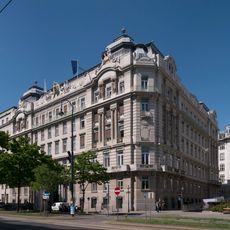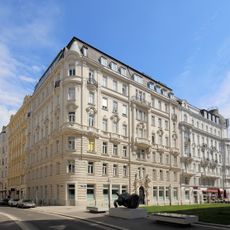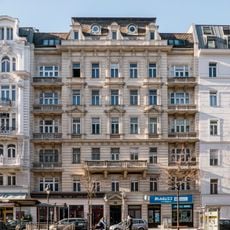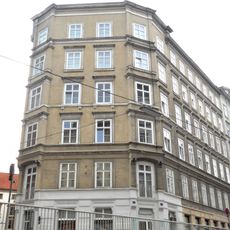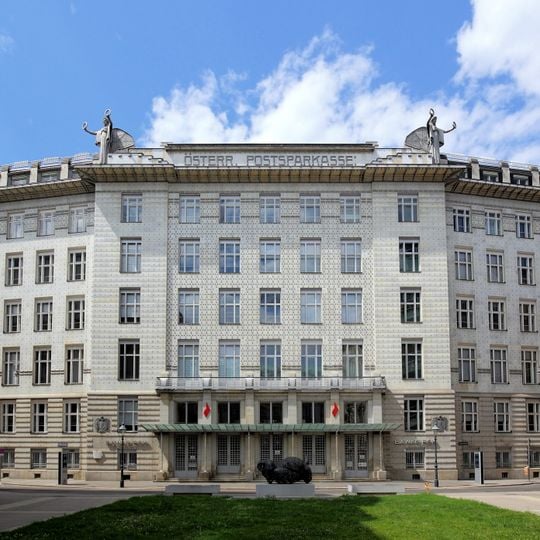
Austrian Postal Savings Bank, Art Nouveau bank building in Innere Stadt, Vienna, Austria
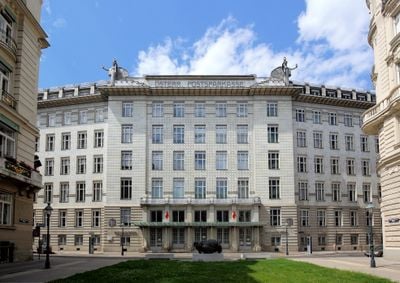
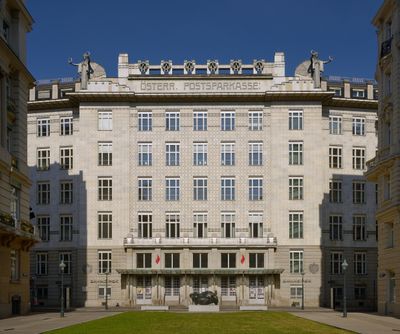
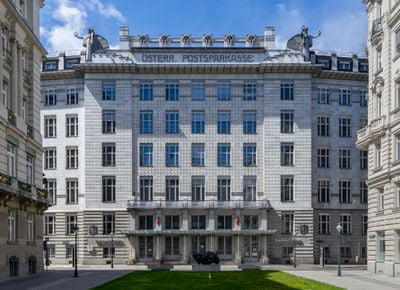
The Austrian Postal Savings Bank features a white marble facade with aluminum rivets, creating a grid pattern across its eight-story structure.
Otto Wagner designed this banking institution in 1904, implementing innovative construction techniques with reinforced concrete and aluminum materials.
The building represents a departure from traditional architecture, introducing modern design principles through its functional layout and material choices.
The central hall contains a glass floor that allows natural light to reach lower levels while serving as the main transaction area.
The facade includes 40,000 bolted marble plates and aluminum decorations, making the exterior resemble a giant safety deposit box.
Location: Innere Stadt
Architects: Otto Wagner
Architectural style: Art Nouveau architecture
Address: Georg-Coch-Platz 2
GPS coordinates: 48.21000,16.38030
Latest update: May 27, 2025 13:21
Between 1890 and 1910, Art Nouveau spread across Europe, producing buildings that combined craft traditions with industrial techniques through organic forms, natural motifs, and detailed ornamental work. Architects including Victor Horta in Brussels, Antoni Gaudí in Barcelona, and Otto Wagner in Vienna designed structures that departed from historical revival styles, instead emphasizing curved lines, wrought iron elements, and colored glass. The movement encompassed concert halls and railway stations as well as private homes and commercial facades, creating a body of work that remains central to the architectural identity of several European cities. Visitors can trace this development through multiple locations. Brussels offers the Victor Horta Museum, Tassel House, and Hôtel van Eetvelde as prime examples of the Belgian variant. Barcelona showcases Gaudí's Casa Batlló and Bellesguard alongside the Palau de la Musica Catalana with its elaborate tilework. Paris preserves Hector Guimard's Métropolitain entrances and the Lavirotte Building, while Prague presents the Municipal House and the Bedřich Smetana Museum. Nancy serves as a center of French Art Nouveau with the School Museum and Villa Majorelle, and Budapest displays the style through Gresham Palace and the Liszt Academy of Music. From Riga to Turin, Vienna to Belgrade, these buildings document a brief but influential period when architects reshaped urban environments across the continent.
University of Applied Arts Vienna
226 m
Regierungsgebäude, Vienna
137 m
Zollamtsbrücke
306 m
Radetzky-Denkmal
177 m
Aspernbrücke
242 m
Zollamtssteg
306 m
Zollamtsbrücke
306 m
Wientalverbauung außerhalb des Stadtparks, Uferpromenade
283 m
Stubenring 6
138 m
Ministerienbrunnen
176 m
Former Wirtschaftskammer Wien building, Stubenring
136 m
Georg-Coch-Platz 3
100 m
Postgasse 8-12, Vienna
80 m
Ferryman, 1997
82 m
Badeschiff Wien
229 m
Dominikanerbastei 5, Vienna
115 m
Stubenring 14
162 m
Stubenring 18
193 m
Kokoschka monument, Vienna
253 m
Georg Coch monument, Vienna
130 m
Schallautzerstraße 4
289 m
Stubenring 4
152 m
Wohn- und Geschäftshaus
174 m
Ehem. Verlagshaus und Druckerei Gerold
113 m
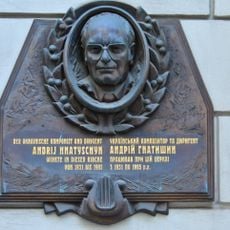
Gedenktafel für Andrij Hnatyschyn
104 m
Durchhaus
156 m
Miethaus
133 m
Wientalverbauung in der KG Innere Stadt
283 mReviews
Visited this place? Tap the stars to rate it and share your experience / photos with the community! Try now! You can cancel it anytime.
Discover hidden gems everywhere you go!
From secret cafés to breathtaking viewpoints, skip the crowded tourist spots and find places that match your style. Our app makes it easy with voice search, smart filtering, route optimization, and insider tips from travelers worldwide. Download now for the complete mobile experience.
A unique approach to discovering new places❞
— Le Figaro
All the places worth exploring❞
— France Info
A tailor-made excursion in just a few clicks❞
— 20 Minutes