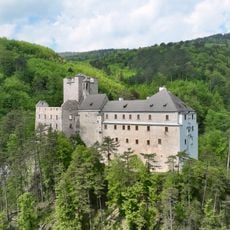
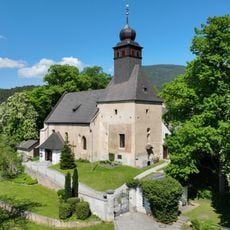
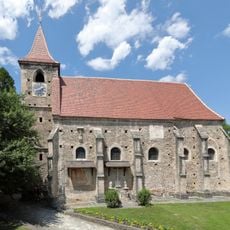
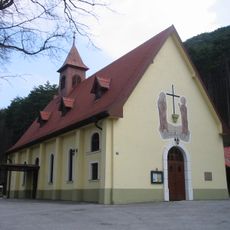
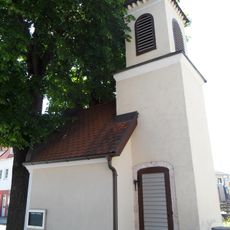
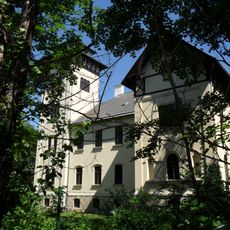
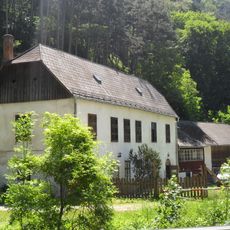
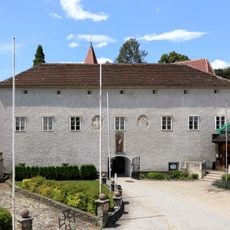
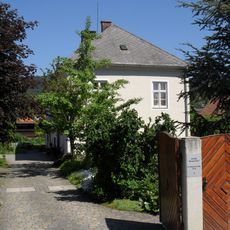
Schloss Vöstenhof, Renaissance castle in Bürg-Vöstenhof, Austria.
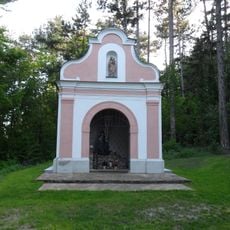
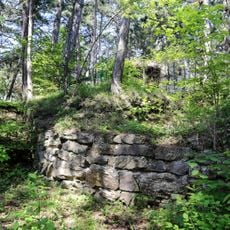
Schloss Vöstenhof is a medium-sized castle in Bürg-Vöstenhof, Lower Austria, set in its own park on slightly elevated ground. It has an almost square plan with a large outer courtyard and a small inner courtyard. Surviving historic elements include sections of the perimeter wall and corner bastions. The main tower in the west corner of the north wing, probably the core of the medieval keep, has a ground floor with a cross-vaulted ceiling. The north facade carries two 17th-century reliefs, and the 13th-century chapel, with a 16th-century cross-vaulted ceiling and 16th-century carved wooden pews, projects partly into the inner courtyard of the west wing.
Built probably in the 13th century as Feste zum Hof, the castle passed from Albero Stuchs von Trautmannsdorf to Duke Albert III in 1381. Hieronymus Wurmbrandt bought it in 1592 and had it rebuilt as a Renaissance palace in 1597. The counts of Hoyos owned it from 1621 to 1912, letting it decay until restoration began in 1894; the keep was raised and the facade renewed in 1910–12, after which the Schwarzenbergs and then the Czernins took over.
The name Vöstenhof derives from the medieval "Feste zum Hof", later recorded as "Hoff zu Neydeckh" while held by the Neidegger family until 1592. Inside, the castle chapel built in the 13th century projects partly into the inner courtyard of the west wing; its cross-vaulted ceiling and richly carved wooden pews date from the 16th century, while the stained glass is a 20th-century addition.
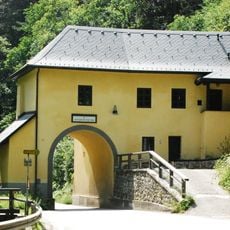
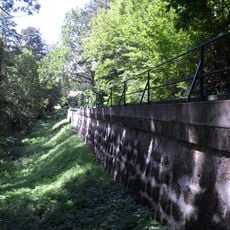
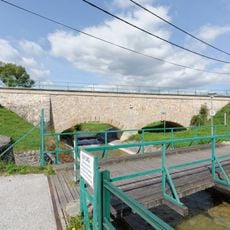
Schloss Vöstenhof is privately owned and not open to the public, so visits are not possible; the building can only be viewed from outside. It stands slightly elevated within its own park in Bürg-Vöstenhof, surrounded by remains of the wall and corner bastions. The stone bridge over the dry moat leads to the arched portal in the low gate tower.
The 1910–12 works that raised the keep and renewed the facade came after the Hoyos era: the counts of Hoyos owned the castle from 1621 to 1912 and had let it decay through the 19th century, with restoration only beginning in 1894. The Schwarzenberg princes bought it afterwards, and it later passed to the Czernin family.
The community of curious travelers
AroundUs brings together thousands of curated places, local tips, and hidden gems, enriched daily by 94,134 contributors worldwide.