Kaasgrabenkirche, Parish church in Döbling district, Vienna, Austria.
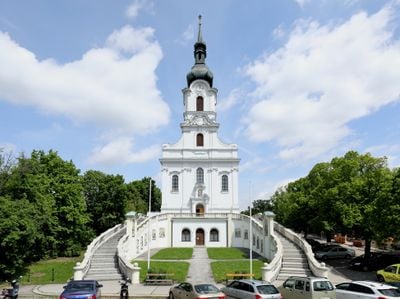
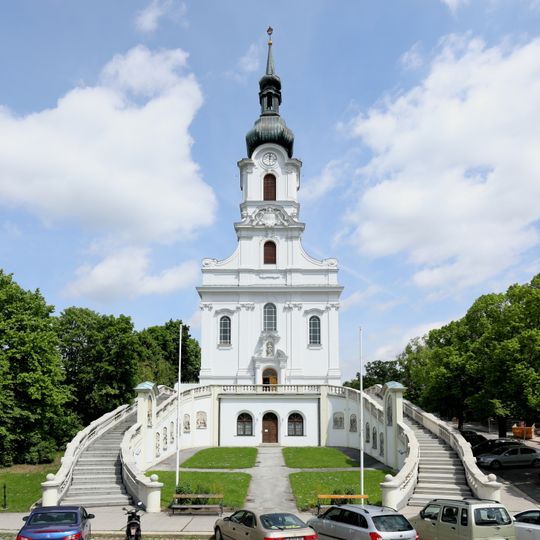
Kaasgrabenkirche is a neo-baroque Roman Catholic pilgrimage church in Grinzing, Vienna, built by Gustav Orglmeister and Franz Kupka in 1909–1910. Its horseshoe-shaped double staircases carry stone reliefs of the Stations of the Cross by Franz Abel and Paul Paintl, and the bright interior centres on a baroque Madonna figure above the high altar.
The Kaasgrabenkirche grew from a chapel built in 1883 by sand-pit owner Kothbauer, who placed a revered pietà there and ran a Heuriger beside it. After the 'pious' business closed in 1903, Stefan Esders bought the land, demolished the chapel and funded a new church, built 1909–1910 by Gustav Orglmeister and Franz Kupka and consecrated on 30 April 1910.
The church is a popular wedding church, and its horseshoe-shaped double staircases carry stone reliefs of the Stations of the Cross by sculptors Franz Abel and Paul Paintl, who also made the Stations pictures inside. A modern chapel in the church commemorates the Danube Swabians expelled from Yugoslavia and Hungary.
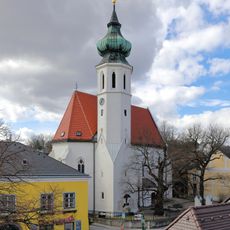
The church stands at Ettinghausengasse 1 in Grinzing, in Vienna's 19th district of Döbling. The horseshoe-shaped double staircases with the stone Stations of the Cross lead up to the entrance, so visitors approach the church from above the street. The tower with its four bells is visible from a distance and serves as a landmark when finding the way.
The name comes from a mineral-rich spring in the area that had a color and smell resembling whey. This unusual naming reminds visitors today of the natural water source that once defined the location.
The community of curious travelers
AroundUs brings together thousands of curated places, local tips, and hidden gems, enriched daily by 92,832 contributors worldwide.