Theresienkirche, Parish church in Hungerburg district, Innsbruck, Austria
The Theresienkirche is a Roman Catholic parish and pilgrimage church on the slope of the Nordkette in Innsbruck's Hungerburg district, built in 1931–32. It is a longitudinal hall church with block-like, largely unarticulated walls, a cubic tower at the southwest corner rotated 45° from the nave axis, and a rounded apse to the north. The parish house and Carmelite monastery adjoin to the west.
A church-building association founded in 1910 provided the land at Gramartstraße/Hungerburgweg. A provisional church was set up in a garden house in 1927, and the present church, financed by donations and a brick drive of 46,000 bricks, was consecrated on 19 June 1932. Expropriated by the Nazi party in 1941, it was sold in 1942 and earmarked for demolition after the war. Carmelite friars took over pastoral care in 1983.
Max Weiler painted the nave frescoes from 1945, completing them in 1948; they include Der Lanzenstich, Die Herz-Jesu-Sonne, Die Johannesminne, Ölberg and Die Herz-Jesu-Verehrung. A blue horse and figures in Tyrolean dress in the Crucifixion scene provoked a dispute that led to a police operation protecting the paintings, and they were covered from 1950 to 1958. The triumphal arch carries Ernst Nepo's 1935 depictions of the Holy Family, St Theresa, Christ and angels.
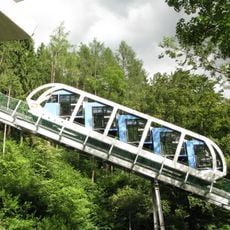
The church sits at Gramartstraße 4 and is easily reached by the Hungerburgbahn funicular or local buses. Regular services take place throughout the week, and visitors are welcome to attend or explore the building.
In a 1930s "brick campaign", believers carried 46,000 bricks from the city up to the building site. The church was consecrated on 19 June 1932, and the image and relic of Thérèse were transferred from the emergency chapel in a garden house.
The community of curious travelers
AroundUs brings together thousands of curated places, local tips, and hidden gems, enriched daily by 93,066 contributors worldwide.