Griechenbeisl, Historic restaurant in Innere Stadt, Vienna, Austria
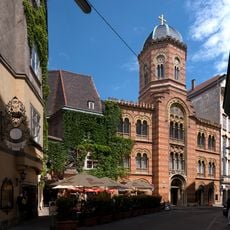
Griechenbeisl is a restaurant at Fleischmarkt 11, on the corner of Griechengasse, beside the Holy Trinity Greek Orthodox Church. The building was first recorded in 1350 and grew over the centuries, so its floors sit at different levels. Eight dining rooms date from different periods, among them the Zitherstüberl, the Mark Twain Zimmer and the round table of the Rundes Zimmer. A narrow spiral staircase leads to the Augustin Stuben upstairs.
The building was first documented in 1350 and sold to Lilienfeld Abbey in 1385; the inn itself is recorded from 1447. It was called Zum gelben Adler around 1500, Zum Goldenen Engel in 1762 and Reichenberger Beisl, taking the name Griechenbeisl after Greek and Levantine merchants settled around Fleischmarkt in the mid-17th century. In 1852 host Leopold Schmied first served Pilsner Urquell in Vienna here.
The name comes from the Greek and Levantine merchants who settled around Fleischmarkt in the mid-17th century, when the area became known as the Griechenviertel. The house took its name from them, yet the kitchen has always served Viennese dishes. A figure of the singer and bagpiper Marx Augustin sits by the entrance under the doormat, and coins can be dropped into his hat.
The restaurant sits on Fleischmarkt and serves traditional Viennese dishes such as schnitzel, Tafelspitz, and homemade Sacher cake. Expect longer wait times, especially during peak tourist seasons.
During renovation work in 1963, three stone balls were found; popular tradition linked them to the First Turkish Siege of Vienna in 1529, though they more likely date from the bombardment during the Second Siege in 1683. They are set into the wall to the right of the stairs up to the Augustin Stuben and remain visible to guests.
The community of curious travelers
AroundUs brings together thousands of curated places, local tips, and hidden gems, enriched daily by 93,518 contributors worldwide.