Sebastianskirche, Baroque church in Altstadt, Salzburg, Austria.
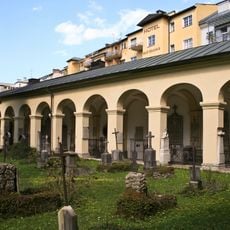
Sebastianskirche is a late-baroque hall church with a barrel vault, built in 1749–1753 to plans by Kassian Singer. A facade tower with an onion dome and lantern projects into Linzergasse. Inside, the 1752 wrought-iron choir screen by Phillipp Hinterseer incorporates iron roses, vines, vases and shells.
The first church was built by the Sebastiansbruderschaft around 1500 and consecrated in 1511, outside the city walls beside a plague cemetery, which explains the dedication to Saint Sebastian. The present late-baroque hall was built in 1749–1753 to plans by Kassian Singer and consecrated in 1754. The city fire of 1818 destroyed Paul Troger's ceiling fresco and high altarpiece; the church was restored in simplified form by 1821.
The church is run by the Priestly Fraternity of St. Peter, which celebrates Mass here in Latin according to the pre-Vatican II rite. Its patronal feast is held on 20 January, the feast of St. Sebastian, invoked against the plague. The church was long a branch of St. Andrä parish and served as its parish church from 1861 to 1898 and again from 1944 to 1952.
The church stands on Linzer Gasse in the right-bank new town, its facade tower projecting into the street; the entrance is through the tower ground floor. The adjoining Chapel of St. Philip Neri, built in 1684, connects the church portal and rear nave with the Sebastiansfriedhof arcades. Mass is celebrated in Latin in the pre-Vatican II rite by priests of the Fraternity of St. Peter.
The organ, completed by Karl Mauracher in 1828, was the first in Salzburg with a chromatic keyboard and no short octave; it survives almost complete with one manual, pedal and 12 stops. Mauracher is also linked to the spread of the carol Silent Night between 1818 and 1829.
The community of curious travelers
AroundUs brings together thousands of curated places, local tips, and hidden gems, enriched daily by 93,565 contributors worldwide.