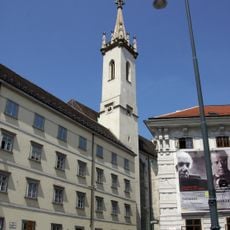
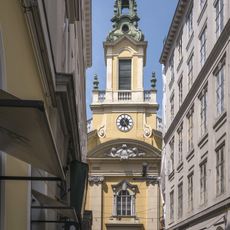
Königinkloster, Vienna, Medieval monastery in Vienna, Austria
Königinkloster, properly Klarissen-Kloster St. Maria, Königin der Engel, was a Poor Clares convent founded around 1580 by Elisabeth of Austria. Its convent church was built in 1582–1583; the site lies between Dorotheergasse, Josefsplatz, Bräunerstraße and Stallburggasse. Today the area holds the Palais Pallavicini and Palais Pálffy and the Lutheran and Reformed City Churches.
Elisabeth of Austria founded the Clarisse monastery around 1580; its church was built in 1582–1583 and she was buried there in 1592. Empress Anna (1618) and Emperor Matthias (1619) were interred here, and the separately buried hearts of Matthias, Anna and Ferdinand II were kept here until the three urns were moved to the Habsburg heart crypt in the Loreto Chapel of the Augustinian Church. The monastery was dissolved in 1781 under Josephinian reforms; Elisabeth's remains went to the Ducal Crypt of St. Stephen's Cathedral.
The name Königinkloster, "Queen's Monastery", refers to St. Mary, Queen of Angels, to whom the Clarisse convent was dedicated. After 1781 the Lutheran congregation took over the former convent church, and the three towers had to be removed because the Tolerance Patent forbade Protestant churches from being recognisable as such from outside. The Reformed congregation built Vienna's first purpose-built Protestant prayer house on its share of the site.
The grounds are separated from public space, but parts are open to visitors on certain days, especially when services take place. Anyone wanting to see the complex should check opening hours in advance.
The site is bounded by Dorotheergasse, Josefsplatz, Bräunerstraße and Stallburggasse; opposite stood the Dorotheerkloster, dissolved in the same Josephine reforms. In 1887 Vienna's 6th district named Königsklostergasse after the convent, which had held a Meierhof in Mariahilf from 1582.
The community of curious travelers
AroundUs brings together thousands of curated places, local tips, and hidden gems, enriched daily by 94,027 contributors worldwide.