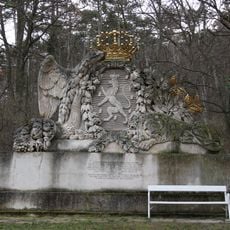
Königshöhle, Natural limestone cave in Baden, Austria
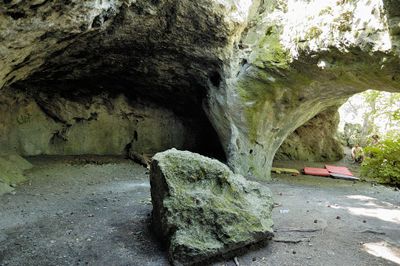
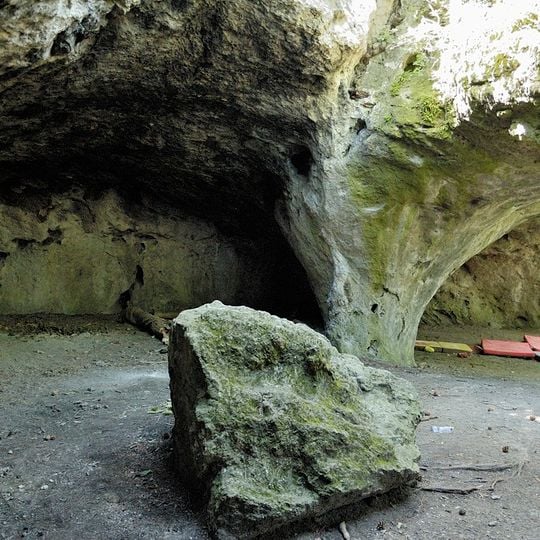
Königshöhle is a cave in the Wolfstal, a narrow ravine west of Baden in Lower Austria, at about 350 m elevation on the northwest slope below the Rauhenecker Plateau. Its entrance portal is 16 m wide and 3 m high, and the cave reaches a depth of 25 m. Beneath a four-metre-wide opening in the ceiling lies a large collapsed block.
The cave was inhabited during the Neolithic period and early Bronze Age, with numerous finds confirming this long occupation. Systematic excavations in the 1920s brought prehistoric objects to light that transformed our understanding of these early cultures.
The cave gave its name to the Baden culture, a Neolithic group defined in 1956 by the Hungarian archaeologist János Banner. Excavations in the ash layer yielded amphora-like vessels, flat bowls with varied decoration, cups and jugs with high band handles, and cylindrical-neck pots with cord loops. A clay spoon may belong to the Lengyel culture.
The inner area is accessible through an easily reachable entrance, though sturdy footwear is recommended because of the damp and uneven ground. Visitors learn more about the excavations at the Rollettmuseum in Baden, which displays the recovered objects.
Among the finds was a copper neck ring with eyelets, a type of ornament from the early Bronze Age. The cave also yielded a fragment of a coin of Emperor Gratian (359–383), the latest object from the site. The cave was declared a natural monument in 1973 and is now used for bouldering.
The community of curious travelers
AroundUs brings together thousands of curated places, local tips, and hidden gems, enriched daily by 93,944 contributors worldwide.