Stubenbrücke, Heritage-protected bridge over the Wien River in Innere Stadt, Vienna, Austria
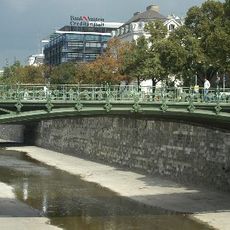
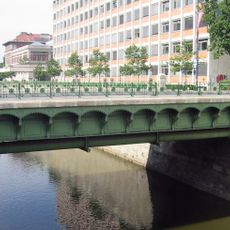
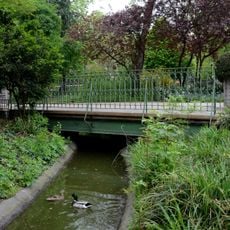
Stubenbrücke is a bridge over the Wien River linking Innere Stadt and Landstraße, built 1899–1900 to designs by Friedrich Ohmann and Josef Hackhofer. Its iron truss girder was made by Ignaz Gridl, replacing an earlier stone bridge at the Stubentor.
A bridge has stood here since at least the early 15th century, carrying the road from the Stubentor toward the Nikolai suburb, the Cistercian convent and Landstraße. The present structure was built in 1899–1900 to designs by Friedrich Ohmann and Josef Hackhofer during the regulation of the Wien River, replacing the stone Stubentorbrücke. Its wrought-iron truss was made by Ignaz Gridl. It was renovated after World War II and in 1959, and since 1991 the U3 line has run beneath the river here.
The bridge's name comes from the Stubentor, the city gate it once faced. From 2001 to 2021 four aluminium "Lemurenköpfe" (lemur heads) by artist Franz West stood on its pylons, made for his MAK exhibition "Franz West: Gnadenlos"; removed for restoration in 2014, they returned on 28 January 2016 before being given back to the lenders.
The bridge carries pedestrians and cyclists between the Innere Stadt and Landstraße banks of the Wien River. Since 1991 the U3 metro line has run in the tunnel beneath the river at this point, so the crossing can be combined with a U-Bahn stop nearby. Look for the bridge where the Wien River approaches its mouth at the Danube Canal, downstream of the Stadtpark.
Four aluminium lemur heads by Franz West stood on the bridge pylons from 2001, made for his MAK exhibition "Gnadenlos". Meant as temporary, they stayed as a permanent loan, were removed for restoration in late 2014 and remounted on 28 January 2016; the loan ended on 9 June 2021 and the heads went back to the lenders.
The community of curious travelers
AroundUs brings together thousands of curated places, local tips, and hidden gems, enriched daily by 94,051 contributors worldwide.