Schermberg, Mountain summit in Upper Austria, Austria
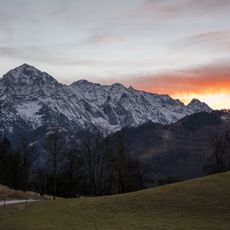
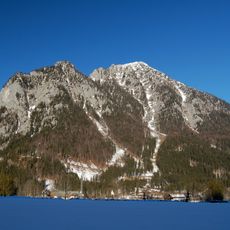
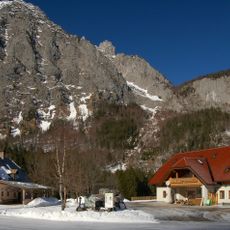
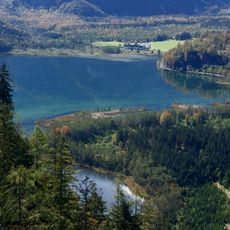
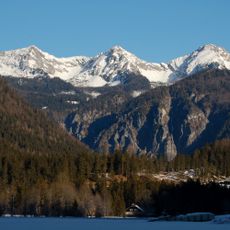
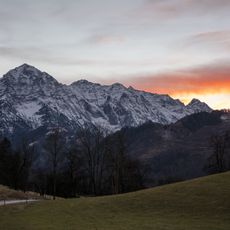
Schermberg is a mountain summit in Upper Austria with steep slopes and rock faces that characterize the northern Alpine region. The peak stands at the convergence of several established walking and climbing routes.
The first ascent of the Schermberg north face was made in 1929 via the Welser and Linzer routes. On 16 December 1930, those climbers founded the Alpine guild D'Schermbergler, which erected a three-legged summit marker in 1932. Since 1934 the Schermberglauf, a giant slalom from the pre-summit down about 200 metres to the Fleischbanksattel, has been held.
The name Schermberg comes from the Old German "Scherm", meaning screen or shelter. On 16 December 1930, climbers who had first ascended the north face in 1929 founded the Alpine guild D'Schermbergler, which erected a three-legged marker on the summit in 1932. Since 1934 the Schermberglauf, a giant slalom from the pre-summit down about 200 metres of height to the Fleischbanksattel, has been held. The guild, part of the Wels section of the Austrian Alpine Club since 18 May 1951, had 34 members in May 2019.
Marked trails connect the summit to nearby valleys and villages, with routes varying in difficulty depending on the approach. Walkers should plan visits outside winter months when snow and ice make access more demanding.
The north face drops 1,400 m, making it the third-highest wall in the Eastern Alps after the Watzmann east face and the Triglav north face. It closes off the Hetzau, described as the largest landslide valley in Europe. The name comes from the Old German "Scherm", meaning screen or shelter.
The community of curious travelers
AroundUs brings together thousands of curated places, local tips, and hidden gems, enriched daily by 93,691 contributors worldwide.