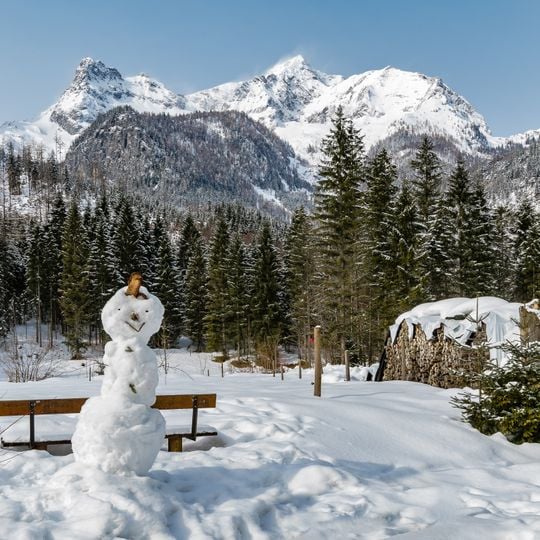
Großer Priel, Mountain peak in Totes Gebirge, Austria
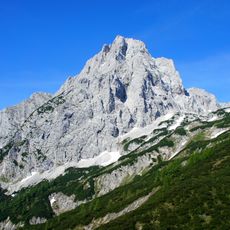
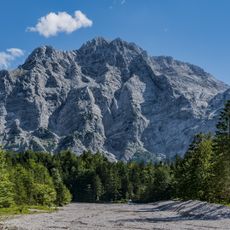
The Großer Priel is a 2,515-metre summit in the Totes Gebirge, the highest point of that range and the northeastern corner pillar of its karst plateau. Its upper part is banked Dachstein limestone rising in steep walls on all sides, over a base of Wetterstein dolomite; the west ridge links it to the plateau at the Fleischbanksattel. The east side is cut by four ridges enclosing the Kirtagkar, Goldkar and Kühkar cirques, and the Kühkar holds the northernmost permanent firn field in the Alps.
The Großer Priel was first recorded as Pruell in a 1584 deed; Georg Matthäus Vischer's 1667 map of Upper Austria labelled it mons altissimus totius provintzia. Archduke John of Austria described the peak in his 1810 travel diaries, and the first documented tourist ascent was made on 29 August 1817 by Count Franz Sigmund von Engl, guided by the hunters Hans, Anton, Engelbert and Ferdinand Riedler. Archduke Louis of Austria followed on 14 August 1819.
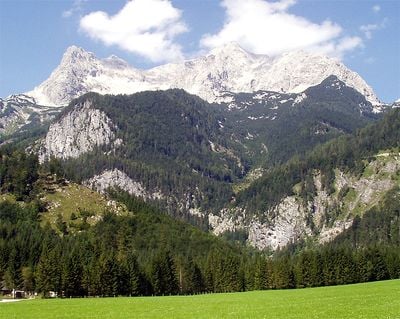
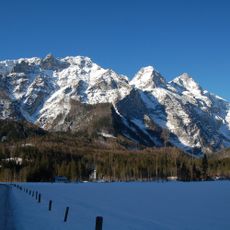
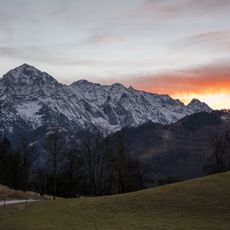
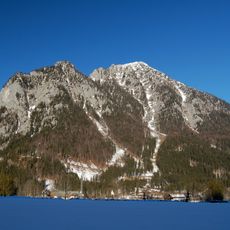
The mountain has long drawn climbers from surrounding areas who ascend via marked routes starting from the mountain huts. The stark white rock faces have become a defining landmark that locals and visitors immediately recognize when looking toward the peaks.
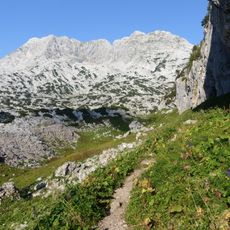
The normal route from the Prielschutzhaus crosses the Brotfallscharte and has a few wire-rope secured passages; the Bert-Rinesch-Steig, built in 1994, is a via ferrata of difficulty C–D. From the Welser Hütte the usual ascent goes over the Fleischbanksattel at 2,123 m. The Priel crossing from the Kleiner Priel along the ridge to the Arzlochscharte involves climbing up to grade II and often requires a bivouac.
The Kühkar cirque on the east side holds the northernmost permanent firn field in the Alps. When the snow cover melted away in 2011, a thin layer of scree over a larger ice body with melt funnels was left as the last remnant of the former glacier. The summit cross standing today is a replica: the original iron cross from 1870, eight metres tall and weighing 2,240 kilograms, was destroyed by a storm on 25 June 2008 and replaced on 17 August 2009.
The community of curious travelers
AroundUs brings together thousands of curated places, local tips, and hidden gems, enriched daily by 93,684 contributors worldwide.