Notgasse Gröbming, Rock formation and petroglyph site in Gröbming, Austria.
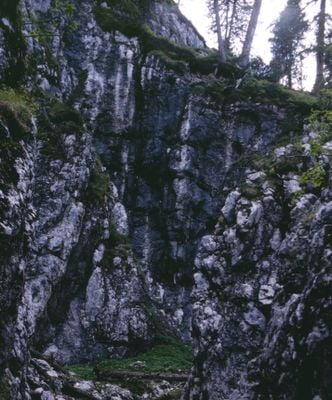
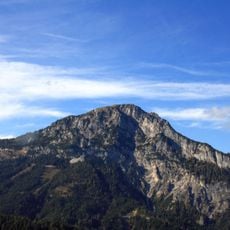
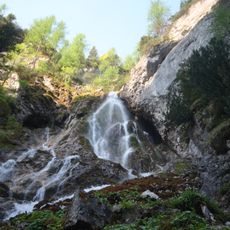
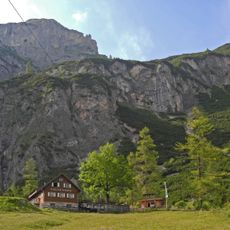
Notgasse is a dry gorge with walls rising up to 60 meters (200 feet), forming a natural pathway at the base of Stoderzinken mountain. The route passes through this rock formation displaying ancient carvings on the stone surfaces that record the presence of past inhabitants.
The gorge was cut by meltwater from the Dachstein glacier around 14,000 years ago, and a trail through it has linked Gröbming with the pastures of the eastern Dachstein plateau and with Aussee and Hallstatt. The oldest dated carving is from 1643; an age of up to 1,200 years is considered plausible, while earlier origins remain speculation. Guide Josef Steiner mentioned the carvings in 1902, and Ernst Burgstaller recorded them between 1961 and 1965.
The passage served as a traditional route for alpine farmers, muleteers, and charcoal burners linking Gröbming to the eastern Dachstein plateau pastures. Local people relied on this path for generations to reach their mountain workplaces and grazing lands.
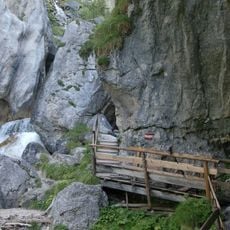
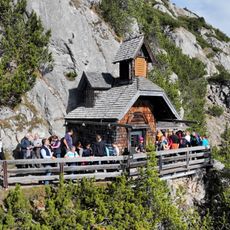
The gorge has been closed by the Austrian Federal Forests since the 1970s for heritage protection and is rarely walked; the terrain is rough and the carvings are hard to find. Guided hikes from the Brünnerhütte on the Stoderzinken are offered by the Gröbminger Land tourism association and the ANISA association in Haus.
The oldest dated carving in the Notgasse is from 1643, but researchers consider an age of up to 1200 years plausible. The symbols, including crosses, triangles, ladders, wheels and pentagrams, remain largely undeciphered. Many sit near the ground because sediment has raised the gorge floor over the centuries.
The community of curious travelers
AroundUs brings together thousands of curated places, local tips, and hidden gems, enriched daily by 93,678 contributors worldwide.