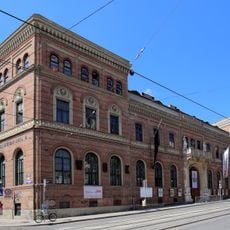
Maschinenfabriken in Wien-Alsergrund, Industrial heritage museum in Alsergrund, Vienna, Austria.
The Maschinenfabriken in Wien-Alsergrund is a Gründerzeit factory complex whose origins reach back to the Biedermeier period. The building erected in 1866 by architect Carl Tietz, with its Währingerstraße wing, served as both administration building and residential palais for industrialist Georg Sigl. Since 2025 the site houses the WUK cultural centre.
Fletcher & Punshon, founded in 1834 in the Roßau, was the first machine factory and steam engine producer in the Austrian Empire; in 1838 it delivered a 140 hp side-lever engine for the DDSG steamer Erös. In 1840 the firm became a joint-stock company, and in 1851/52 Georg Sigl took over the plant, adding printing presses and lithographic presses. The surviving building was erected in 1866 by architect Carl Tietz; the Währingerstraße wing served as Sigl's administration building and residence. The factory closed in 1887.
The name WUK comes from Werkstätten und Kulturhaus, workshops and culture house. Since 1981 the former Sigl factory has housed this centre, and the building also hosted the first Austrian radio broadcast: Radio Hekaphon transmitted from the fourth floor starting 1 July 1923.
The complex stands between Währinger Straße and Michelbeuerngasse in the Alsergrund district; the WUK cultural centre occupies the heritage-protected wing. The site is reached on foot from the nearby tram and metro stops, and the courtyards connect the individual building tracts. The former administration wing on Währinger Straße, once Sigl's residence, is recognisable by its Gründerzeit facade.
From 1 July 1923, Austria's first radio station, Radio Hekaphon, broadcast from the fourth floor of the building. The locomotive works had closed in 1887, and the former factory rooms were already being used by other tenants.
The community of curious travelers
AroundUs brings together thousands of curated places, local tips, and hidden gems, enriched daily by 94,617 contributors worldwide.