Palace of Justice of Brussels, Courthouse in Marolles district, Brussels, Belgium
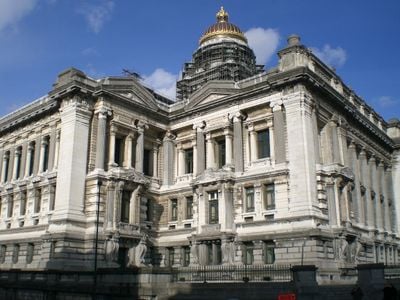
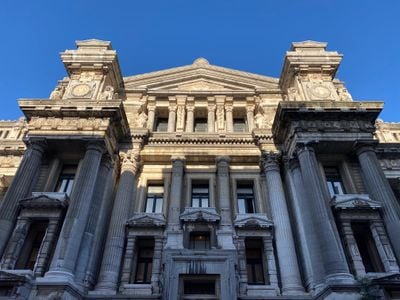
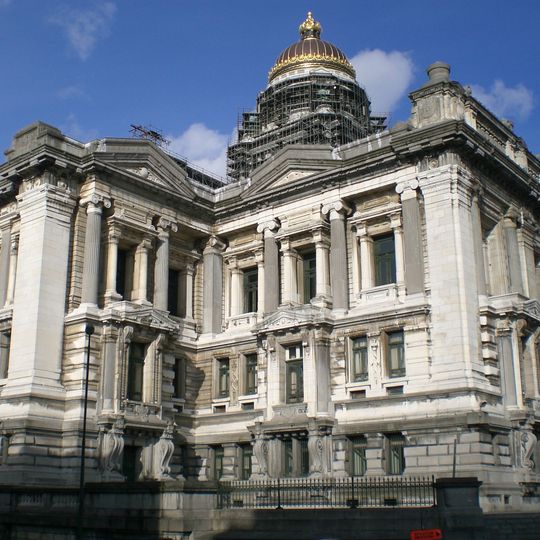
The Palace of Justice is a courthouse on Place Poelaert in the Marolles district of Brussels. Designed by Joseph Poelaert in an eclectic style of Greco-Roman inspiration, it has a rusticated stone base, rows of tall rectangular windows framed by columns and pilasters, heavy cornices, and a central dome crowned with a golden finial. The dome's drum is wrapped in dark scaffolding, and a black metal fence runs along the facade.
The first stone was laid on 31 October 1866, and the building was inaugurated on 15 October 1883 by King Leopold II. Architect Joseph Poelaert died in 1879, and Joseph Joachim Benoît took over the works. The dome was destroyed in World War II and rebuilt higher than the original.
The building's name comes from its role as seat of Belgium's highest courts, including the Court of Cassation. The central hall, the Salle des pas perdus, rises 100 metres to the dome and distributes visitors to courtrooms on the ground floor and upper levels. Sculptor Joseph Ducaju's helmeted bust of Themis crowns the 39-metre portico.
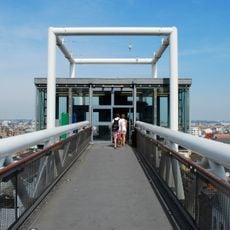
The building sits on the Galgenberg hill between Brussels' upper and lower town, with a 20-metre level difference producing entrances at different heights. The Poelaert Elevators connect Place Poelaert to the lower town, and Louise/Louiza metro station and the Poelaert tram stop are nearby. Scaffolding from 1984 still hangs on the dome drum.
Poelaert planned to crown the building with a stepped top modelled on Babylonian ziggurats, drawn as two or three recessed storeys of light-passing tables on pilasters; it was never built. The dome that stands today was rebuilt higher than the original after its destruction in World War II, and weighs 24,000 tonnes.
The community of curious travelers
AroundUs brings together thousands of curated places, local tips, and hidden gems, enriched daily by 93,403 contributors worldwide.