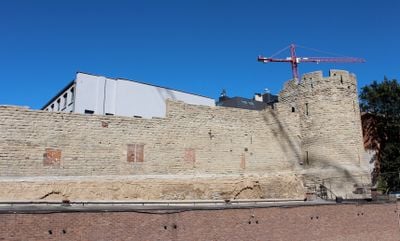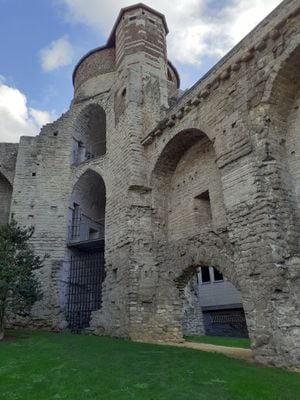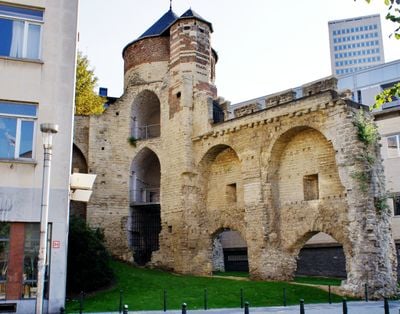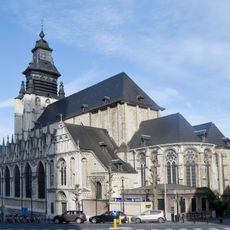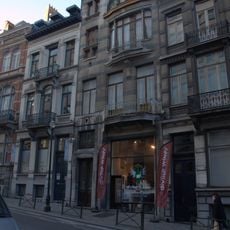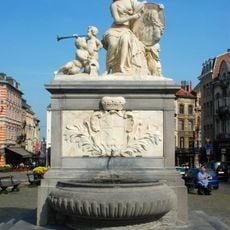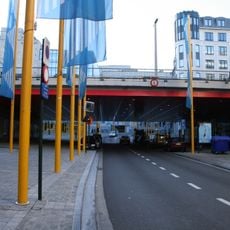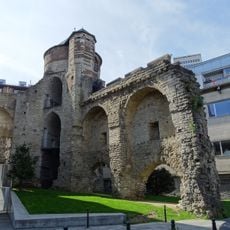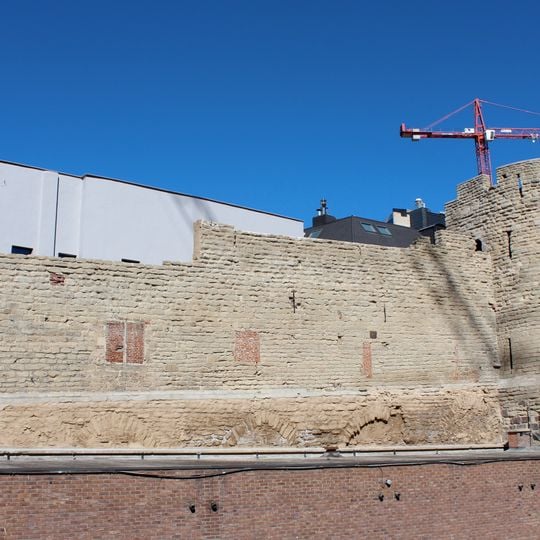
First fortifications of Brussels, Medieval defensive walls in Pentagon district, Belgium.
The first fortifications of Brussels were built of stone and earth: square pillars about four metres apart, linked by arcades buried in a bank, with a wall pierced by arrow slits above and a second arcade carrying a crenellated walkway. The circuit ran four kilometres around Saint-Géry island, the Treurenberg and Coudenberg hills, with some forty towers, a wide ditch and seven main gates. Surviving stretches, such as the Villers curtain wall, show nummulitic sandstone and blocked arches from later housing.
The first wall of Brussels is dated by Paul Bonenfant to around 1100 and certainly before 1134, when a document mentions an oratory extra muros opidi Bruxellensis; Paul Combaz placed its first walls between 1100 and 1120. Guillaume Des Marez, Mina Martens and Georges Despy argued instead for the early 13th century, under Henry I of Brabant, with the wall expressly mentioned only around 1220-1230. After the death of John III of Brabant in 1355 and Louis II of Flanders' invasion, Everard t'Serclaes led the revolt that expelled the Flemings, and the second wall was then decided. The two fortifications long coexisted, and the first was dismantled district by district from the 16th to the 18th century.
The Black Tower, behind the church of Sainte-Catherine, is one of the few remnants of the first wall that can be seen from the public street. Its name comes from its dark stone, and it is the best-known fragment of a circuit that also survives in the courtine and tower of Villers, between the rue des Alexiens and the rue de Villers.
The easiest way to explore these remains is by walking through the Pentagon district and following the streets that still trace the original defensive layout. You can move through the city center on foot and observe how the medieval structure shaped the modern street pattern.
The pentagonal shape created by these medieval walls still defines the city center today and is visible in how modern streets are arranged. This geometric legacy of medieval defense continues to shape how visitors and locals navigate central Brussels.
The community of curious travelers
AroundUs brings together thousands of curated places, local tips, and hidden gems, enriched daily by 93,391 contributors worldwide.