Belfry of Ghent, Gothic bell tower in Ghent, Belgium
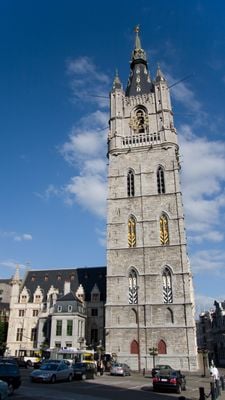
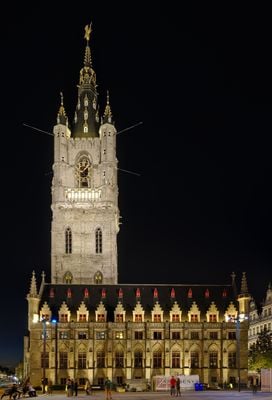
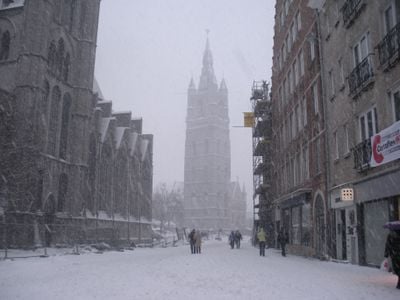
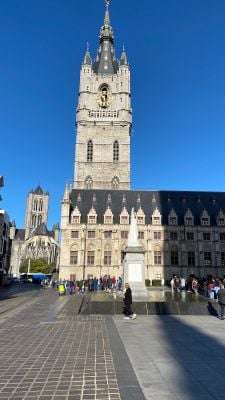
The Belfry of Ghent is a 91-metre square tower of light grey stone, the middle of the city's three medieval towers. Its shaft has paired pointed-arch windows with dark louvers, a projecting balustrade, two gold-numeral clock faces and a steep spire-like roof crowned by pinnacles. A gilded copper dragon, 3.55 m long and weighing 455 kg, turns as a weathervane on top.
Construction began in 1313 and stretched across several decades, interrupted by wars and outbreaks of plague before completion. During this period, the structure evolved into a key symbol of municipal power and prosperity.
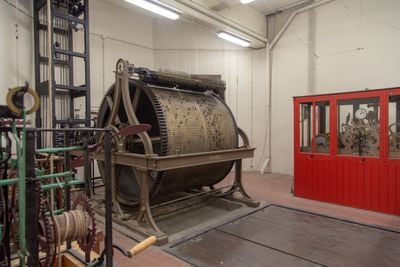
The gilded copper dragon on the spire, 3.55 m long and weighing 455 kg, was made in Ghent in 1377, though legend claims it was taken from Bruges. The carillon of 54 bells, about 30 tons, includes Klokke Roeland of 1948, weighing 6.7 tons. Since 1613 the Sint-Michiels fencing guild has used the two upper floors of the cloth hall, and its 1613 permit remains valid.
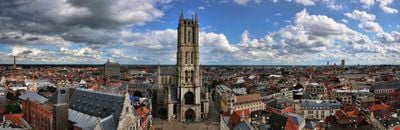
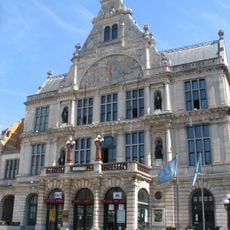
The tower is reached on foot; there is no lift. The climb passes the carillon and the former prison quarters of the cloth hall. The belfry stands in the middle of the three-tower row, between Saint Nicholas' Church and Saint Bavo's Cathedral, with the Mammelokker annex at street level.
The Mammelokker annex of 1741, once the jailer's quarters, takes its name from the sculpture of Roman Charity above its doorway: Pero secretly breastfeeding her father Cimon, condemned to death by starvation. The relief is easy to miss at street level. The upper floors of the adjoining cloth hall have housed the Sint-Michiels fencing guild since 1613, a decision still legally valid.
The community of curious travelers
AroundUs brings together thousands of curated places, local tips, and hidden gems, enriched daily by 93,400 contributors worldwide.