Fort de Flémalle, Military museum and fort in Flémalle, Belgium
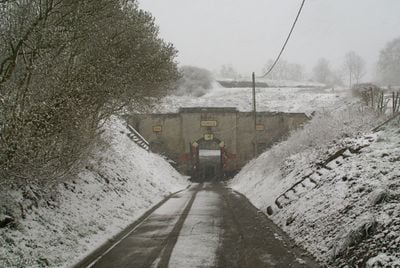
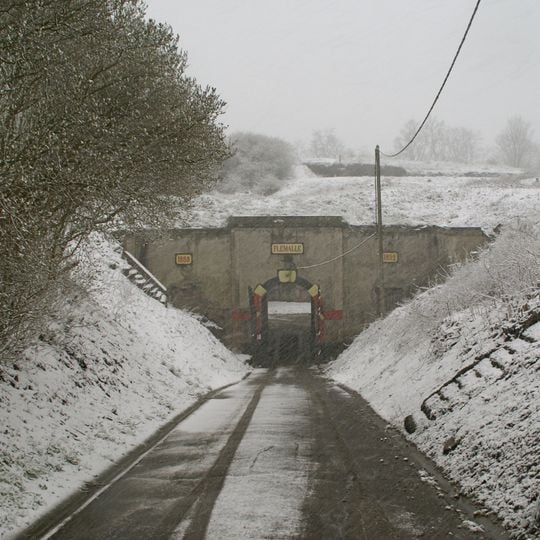
Fort de Flémalle is one of the twelve forts built around Liège, set into an embankment about 7 km southwest of the city centre. Its flat concrete facade has a central arched entrance with a projecting band above, flanked by yellow plaques reading "1888" and "1892" and a central plaque with the name "FLEMALLE". The fort is an irregular trapezoid, almost triangular, encircled by a ditch 6 m deep and 8 m wide, with its main armament concentrated in the central massif.
Built between 1881 and 1884 to General Henri Alexis Brialmont's plans, Fort de Flémalle was one of twelve forts of the Fortified Position of Liège. Bombarded from 14 August 1914, it surrendered on 16 August at 09:30, two hours after Fort de Hollogne, making it the last Liège fort to fall. Modernized in the 1930s with 105 mm and 150 mm turrets, it was attacked again in May 1940.
The fort is preserved as a museum, and its name is tied to the Flémalle plateau above the Meuse. Visitors can see the counterscarp galleries where kitchens, latrines and the morgue were placed, a layout that shaped the garrison's daily life in 1914. The two yellow plaques flanking the entrance arch read 1888 and 1892.
Visitors can explore the underground passages and artillery positions on guided tours offered on the third Sunday of each month. It is best to arrive early and wear sturdy shoes, as the paths on the grounds can be uneven.
The guns fired black powder rather than smokeless powder, filling the confined casemates with choking fumes that spread through the fort's unventilated interior. The Germans found ventilation in 1914 to be almost nonexistent and improved it during their occupation.
The community of curious travelers
AroundUs brings together thousands of curated places, local tips, and hidden gems, enriched daily by 93,585 contributors worldwide.